Showing posts with label tourism. Show all posts

Wednesday, April 5, 2023

A BLIGHT ON THE CERROS – The Blue-mination Of Zihuatanejo

Sally and I love this charming town on the Pacific coast of Guerrero, Mexico called Zihuatanejo. Some 15 years ago, having visited nearly all of Mexico’s coastal resort towns, we found Zihua’s history as a small fishing village and its apparent commitment to growing in thoughtful, human-scale ways really appealing.


But since then controversy has grown over the pace and style of development in Zihua. We understand that those issues must be debated and decided by the citizens and their representatives, not tourists.

But there’s no denying that this town’s lifeblood is tourism. So when locals weigh the costs and benefits of development decisions made by government officials, we listen. And they should know we listen.

     Another transfiguration has been occurring
     in this town that only shows its face at night.

PHOTO: Magdaleno Flores

Of course, many business people, especially those in the hospitality business, are anxious to see the area grow. Those I’ve spoken with want to discourage the visitors who leave behind more trash than pesos—most of them Mexicans—and attract more affluent guests from abroad.

How to accomplish that is where locals differ. Some want to assure that Mexicans, including citizens of Zihua, don’t get steamrollered by politicians’—and their pals’—big ambitions. And that the not so glamorous day-to-day needs of folks who actually live here year-round don’t get ignored.

There are concerns about the spread of shanty neighbor- hoods up the flanks of the cerros, or hills, with no commensurate upgrades to infrastructure. And the removal of mature, healthy trees and swaths of clean, sandy beach to broaden already ample walkways into forty-foot-wide boulevards.

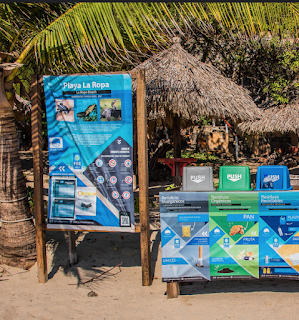
Also debated is the pursuit of “Blue Flag” designation for Zihua’s five main beaches—an international standard town officials have adopted, and which many feel imposes unnecessary restrictions on how both visitors and locals can use the beaches.

      Apparently every single person installing
      a light in those hillside neighborhoods has
      decided on bulbs that have no heart.


HOME FIRES BURNING

As controversial changes like these have come to see the light of day, another transfiguration has been occurring in this town that only shows its face at night.

During our stay this March, as Sally and I dined at some of the cliffside restaurants in La Madera after dark, I observed how much the nightscape—more specifically, the lightscape—has changed in this charming town we’ve come to love.

Most restaurants and lodgings along the beaches are illuminated with an inviting glow, a quality of lighting their owners and managers are smart enough to know evokes warmth, safety and comfort—as light in the range of 1,000 to 3,000 on the Kelvin color temperature scale has since our Neanderthal forebears huddled around campfires.

But as the eye starts climbing the cerros that form the backdrop of the town center, the lightscape changes. And not for the better.

Maybe folks haven’t noticed; some may not care. But apparently every single person installing or replacing a light in those hillside neighborhoods in recent years has decided on bulbs that have no heart.

      Nice, warm LED lights are just as available
      and just as cheap as cold ones.


INFECTION
What I’m seeing is that nearly 100 percent of those bulbs are emitting light of around 5,000 Kelvin—what’s billed in the lighting business as akin to daylight. Sounds innocuous enough, but against a backdrop of darkness this rather blueish hue of light looks far from inviting.


It’s the kind of light people choose for one of three reasons. First, because they’re scared. Maybe they figure that, like having a vicious guard dog chained up outside the back door, the more uninviting you can make your lighting, the fewer burglaries you’ll have.

Or, they may want it for the same reason some folks choose blue headlights for their cars: as a statement of attitude, a form of intimidation.

The third and more likely reason is that the decision isn’t the homeowners’ or landlords’ to make. Maybe it’s city or barrio officials understandably out to save a buck with cheaper LED lighting, who either don’t know or don’t care that nice, warm LED lights are just as available and just as cheap as cold ones.

Either way, the pall of cool, lifeless lighting is spreading up the shoulders of the hills behind El Centro like an infection. And I’m now seeing outbreaks of it popping out lower down, including in a few spots along the south end of Playa
La Ropa.

       People don’t come here to see just a small
       slice of exactly what we’re seeing in parts
       of every big city back home.


WHAT WOULD ANDY THINK?
While Zihua’s “blue-mination” may be good for the city’s—or some officials’—bottom line, or some Zankas’ sense of security, it sure as hell is not good for tourism, the economic lifeblood of this area. Nor, by the way, is it good for people’s health.*

Accepting it is a de facto rejection of what visitors consistently say they find so appealing about Zihua, its warmth, its color, its uniquely human scale. People—at least people like me and my wife—don’t come here to see just a small slice of exactly what we’re seeing in the sketchier parts of just about every big city back home.

I mean is this the enchanting former fishing village of Zihuatanejo, the magical Eden Andy Dufresne dreamed of in The Shawshank Redemption…or some sketchy alley in Detroit or St. Louis?


* Numerous studies have shown that regular exposure to bluish light can stir depression, increase stress and interfere with healthy sleep.

Tuesday, March 14, 2017

MARAVILLAS PEQUENAS 4 -- Small Wonders, Mexican Style

One of the reasons Mexico so resonates with my soul—besides the fact that I was a Mexican fisherman in a previous life—is that I choose to see not just the sanitized, homogenized version of the country offered for consumption by tourists, but a bit of its harder reality.

Yes, this country can put on an exquisitely beautiful face, but it has its problems, as do other countries. There is poverty; there is corruption; there is crime. In most parts scraping out a living is either impossible or brutally hard work.

Visitors who pretend those realities don't exist, expecting things to be just like their own priveleged neighborhoods back home, do both Mexico—and themselves—a great disservice.

       I believe it's as wrong to idealize a country, 
       a culture, a people, as to ignore it.

You can have your sanitized Cancuns and your barricaded all-inclusives; I want to meet those hard-working people, not just my maid or waiter—folks who could never afford to live anywhere near where they wait on tourists—but shopkeepers, construction workers, folks I run into in back-streets miscelaneas.

I want to sample the kind of food and drink they enjoy, meet their incredibly close-knit families, and—with a little bit of forbearance on their part—speak their language.

I guess I believe it's as wrong to idealize a country, a culture, a people, as to ignore it. So I do, indeed, try to notice both those blemishes, those rough edges, and the priceless Aztec gold beneath the patina. I remind myself that they're not so different from the multi-layered reality of my own country of birth. And I keep open a corner of my hobby-photographer's eye—and my heart—for glimpses of both the post-card version and the real Mexico.


Tuesday, June 9, 2015

THE HERE IN THE THERE – Choosing Where to Belong

“We shall not cease from exploration, and the end of all our exploring will be to arrive where we started and know the place for the first time.”
T.S. ELIOT

Human beings’ yearning to belong is universal, timeless. Cave people huddled ‘round a fire felt it; the regulars at Cheers felt it; even hermits, I would suggest, feel it in their own way. It is experienced by not just thinking, sentient creatures, but, in more mystical ways perhaps, by plants, rocks, water, air...in fact, by absolutely everything in the cosmos.

PHOTO: WikiMedia Commons / Happy Midnight

This is not to say that everyone and everything finds that place of belonging; all are constantly moved—often transformed—by forces and circumstances beyond their control. We human beings are unique in that we can sometimes influence those circumstances, a capacity a tree, a cloud or the moon does not possess. More importantly, we can choose where to belong.

       There is a kind of belonging that suggests 
       not so much the nucleus of one’s being as 
       a kind of centrifugal force around it.

A MORE EXPANSIVE SENSE OF PLACE
For the human animal, there are two kinds of belonging. The oldest, most primal is the inner-circle version, in which we embrace the familiar: home and family, accustomed routines and traditions. Our attention, our energy, is directed toward a nucleus of people and place. It is a comfortable place, one we love, at least in part, for the fact that it asks very little of us.

There is another kind of belonging, though. One that suggests not so much the nucleus of one’s being as a kind of centrifugal force around it. Though usually tethered to a home base, this kind of belonging yearns to spin off, propelled to new places and experiences. It moves us to experience a more expansive sense of place, one that embraces and celebrates the unfamiliar.

You could call it simply tourism, I suppose, but that would miss the point. We’ve all met those “résumé” travelers who collect passport stamps like chests-full of medals to show off at cocktail parties. These folks—the kind who settle for the two-bit tour or, worse, lock themselves into gated, all-inclusive resorts; the kind who expect things in Timbuktu to be just like they are back in Terre Haute—must be quite lonely indeed. For here they are departing their tried-and-true, inner-circle sense of belonging, only to miss the most rewarding aspects of leaving it: opening one’s heart and mind to new ways of belonging.

                I want to feel I belong—as we 
                all indeed do—to everything.

No, I see my “centrifugal” sense of belonging as a compulsion to embrace—and become embraced—by as many places and cultures as possible. Not just in my own neighborhood; not just in some small town I can drive to in a few hours; not just in our adopted second home town in Mexico. I want to feel I belong—as we all indeed do after all—to everything.

PHOTO: NASA / ESA

SEEDS OF INTENTION
Chase a sense of belonging by leaving behind all that's safe and familiar? Isn't that an oxymoron? I'll never forget the first time I understood why it made perfect sense. Sally and I were in Puerto Vallarta, Jalisco, Mexico. It was dusk. We'd decided to venture a few blocks past the nearly palpable boundary of the "tourist" area downtown.

As we walked along, dodging playing kids and sleeping street dogs, the sounds and smells of life in people's homes wafted out to us. I turned to Sally and said, "Wouldn't it be amazing if we could just walk into one of these homes and be part of their lives for an evening?"

I've had this feeling, this romantic notion of belonging to another family, another culture, many times since. And, perhaps in part because I'd planted the seeds of intention—and certainly empowered by my gaining near-fluency in Spanish—I’ve indeed been able to fulfill that desire on many occasions in my travels. Those people and places continue to feel like home to me, and will for as long as I live.

          It is about as far from belonging as a 
          picture of a tomato is from a tomato.

FROM A CONSUMPTION MENTALITY 
TO SEEING GENEROUSLY
Travel, aside from being the lifeblood of a romantic, is a consummate teacher. More than just inviting us in to new places and cultures, it asks something of us—to risk, to stretch, to learn, to feel deeply. By not only seeing, but experiencing how other human beings far away live, we learn to appreciate—or perhaps change—the way we live. It can be at the same time empowering and humbling.

That investment of oneself in new experiences and perspectives is what I call seeing generously. It takes the ever-more-prevalent notion that experience is something we merely consume, something we can simply pay for with money, and turns it around. Seeing the world from this perspective, we gladly invest in travel experiences with our time, our curiosity, our caring. One can do it in any number of ways: volunteer with a local organization; take a personal interest in a child or a family; teach; paint, photograph or write about the people and customs; learn the language.

PHOTO: Pack For a Purpose / PackForAPurpose.com

I’m afraid we’ve become a culture where, too often, our social interaction amounts to sitting at home or with friends and, instead of sharing our thoughts and feelings with the folks who are right there in front of us, pretending to connect with other people and places spoon-fed to us, virtually, by some digital device. This asks virtually nothing of us. It is about as far from belonging as a picture of a tomato is from a tomato. 

Another troubling change I’m seeing is our growing expectation of nearly instantaneous, “on-demand” results, and the illusion that we can always be in control of those results. What seeing generously teaches is that, instead of expecting to change our surroundings to suit us, we’re willing to change ourselves to suit our surroundings.

The world could be a far more vital, healthy, peaceful place if only we realize the estrangement we’re allowing these trends to inflict on us. We need to reclaim what is real. And, no matter how much everything else might change, what is real will always mean belonging—whether gathered with loved ones ‘round the fire (a real fire, not one of those HD continuous video loops of one) or reaching out to embrace, first-hand, new people and places.

     We realize who we are, and that we all       
     belong to the same family, the same place.

GET OUT THERE!
The wonderful thing about these two inward- and outward-directed senses of belonging is that you don’t have to choose. Far from taking the place of home-centered belonging, the kind of belonging-by-exploring I love so much actually reinforces it. Even when I’m lucky enough to be accepted into another culture for a while, I know very well where my real home is, and the adventure, the perspective, only makes me appreciate it all the more.

And it’s not that I want to escape; it’s that, at home, I take belonging—and everything else—for granted. That, ironically, makes me feel empty. It reminds me how much I need that incredible sense of putting myself out there, learning, seeing things in new ways through the eyes of others who, at first, may seem so utterly different from me. For it is only by opening up and reaching out that we realize who we are, and that we all, indeed, belong to the same family, the same place.

So, as much as you enjoy hanging out at home with your family and friends, make a point to get out there now and then. See generously. Open your mind, heart and spirit to new people and places. Dare to venture beyond the barriers of your assumptions. Find out what it means to embrace the unfamiliar and make it your own. Discover the here in the there.

PHOTO: Pixabay


Tuesday, March 17, 2015

THE PRICE OF PARADISE

I sit in my dimly-lit hillside villa, overlooking Zihuatanejo Bay. A thin sprinkling of lights suggests the water's outline, the black void itself punctuated by just a row of swaying white anchor lights atop the masts of sailboats moored just off the beach. Beyond them, nothing but the Pacific some 8,000 miles to New Zealand.

Our living room has only three walls; the fourth, seaside, was never built, never needed in this mild-to-hot, two-season climate. Instead, a planter of pink bougainvillea spans the room, integrated with the formed-concrete structure as if it had all come out of the same mold.

So the delicious Pacific air, calmed from this afternoon's rambunctiousness, wafts in, as does the agreeable sound of live Santana covers from the beach down the hill and two blocks away. Still, every twelve or thirteen seconds the surf, like some insistent old lady, tries to hush the band.

   Occasionally, a sound makes me stop what 
   I'm doing and reminds me that this is Mexico.

CHARROS AND CHACHALACAS
Our end of Zihuatanejo—the La Ropa neighborhood—is usually pretty quiet. Its only arterial road passes the front entrance of our little cluster of rented villas, but traffic noise just kind of blends into the soundtrack of life—birds, people chatting, some construction activity down the street, and, always, the surf.

Occasionally, though, a sound makes me stop what I'm doing and reminds me that this is Mexico: ranchero music blaring out of some guy's truck; the hypnotically simple flute melody advertising the itinerant knife-sharpener with his foot-powered grinding wheel; and, just this morning, the commanding squawk of a few onomatopoeically-named chachalacas, a nearly pheasant-sized bird we're hearing in our part of town for the first time this year.

Sometimes, it's smells: the haze of wood smoke from brush fires in the surrounding countryside; the fresh, clean scent of the cleaning solution they mop our floors with every day; the floury, flowery aroma of fresh tortillas.

As I write, no fewer than five geckos cling to my white stucco ceiling, waiting for the unsuspecting bug to fly in. (Last year, we witnessed the epic stalk, strike and swallow when one took down a moth nearly half its size.) Now four of them are exchanging words in the corner of the kitchen. They sound like birds—raspy-voiced ones like grackles.

SHADES OF SERENITY
I'm tired. Sally and I walk the couple of miles into town every day—and back. There are a few long ups and downs along the way, as well as a couple where a similar ascent is concentrated into a much shorter run. Sometimes, we do the walk twice.

And the sun is powerful and pervasive. Even if you're not standing in its full, straight-down blast—the kind Richard Dreyfus experienced at that railroad crossing in Close Encounters—you feel it circumventing the shade of your visor, radiating up off the ground and every other surface all around you. We know now why many Mexicans still honor the tradition of the siesta.

While those who know better nap, we walk. We've learned the fine art of pacing ourselves, taking just a few blocks at a time and then resting a few minutes. We've discovered the choicest spots of shade along the route—several of them doubly blessed with not just shade but zephyrs of bay breeze captured and concentrated by favorably-oriented building walls.

It's not just this soft, moist air; this whole place is delicious. I've written many times about the colors, comparing them with rich, savory, spicy food. The pace of life is unhurried, not just for the locals, who know there's no point in stressing out over things generally beyond their control, but for us visitors, who relish their example.

I dream of gabbing away with a Mexican family in a real, unmitigated conversation over dinner or a game of Conquian or dominó.

TOO CLOSE FOR COMFORT
There's always a sense of adventure here in "Zihua," at least for those of us for whom the locals' everyday experiences seem exotic. The constant presence of the sea. Taking a local bus and pasajero down the coast to La Barra de Potosí or Petatlan. The drama of everyone—from workers to street dogs to huge, prehistoric-looking iguanas—plying always-evolving strategies to compete for scant resources.

There's also the sheer presence of creatures that, simply because we're not used to them, can scare the living bejesus out of you. Last night as I turned back the covers from my side of the bed, I spotted something dark and leggy between the corner of the mattress and formed-concrete bed platform. On closer inspection, it turned out to be one of the biggest spiders I've ever seen—though not a tarantula, it was nearly three inches across.

I'm ashamed that I didn't figure out a way to accommodate the poor thing—like I have so many times, like with bats at home, a scorpion felt inside my pants leg in Texas and cigar-sized cockroaches in Costa Rica. I just couldn't abide the thought of this thing—whose intentions I had no way of knowing—having to scurry just twelve inches to explore my face.

TALKING THE TALK
Part of the adventure, for me, is finding situations in which it's sink or swim with my Spanish. For nearly a decade I've made this beautiful, melodic tongue my second language (actually, third, if you count German, whose hard, guttural sounds have never resonated with my romantic soul). I'm getting pretty good at it, and jump on every chance I get to practice my craft.

The other day, I attended a traditional lamb barbacoa with some fellow guests and friends and family of our host here in Zihuatanejo. I hope I wasn't rude to the non-Spanish-speakers, but I was just irresistibly drawn to the end of the table where all the Spanish speakers were sitting.

When I started learning Spanish about a decade ago, my very first objective was simply to be able to chat amiably with a cab driver about his life, his family and the fortunes of the local futbol or beisbol club. Now that goal has been far surpassed, and I dream of gabbing away with a Mexican family in a real, unmitigated conversation over dinner or a game of Conquian or dominó.

     I find myself unable to decide which is the 
     problem: that things are way more complex 
     than I'll ever know…or way more simple.

A HARDSCRABBLE LIFE
The people here are wonderful. Sure, we've met the occasional surly cab driver or waiter, but the vast majority of our interactions with Zihuatanejenses have been warm and engaging. In so many Spanish-speaking places we've gone, folks assume we're careless tourists who don't really give a rip about their lives and culture.

But here in Zihua., people seem quicker to take you as you are. It doesn't take them long to recognize my considerable investment in learning their language and getting to know a bit about Mexican geography and culture. They seem to really appreciate that. (Of course, I have to be sensitive to the flip side of the culture thing, which is that many Mexicans are eager and proud to show off their increasing grasp of English and of US culture.)

I don't know how Mexicans ever got the reputation, as they did in my parents' generation, of being lazy (This must have arisen in an era in which all "foreigners"—as if there were ever anyone else coming to settle in the US—were seen as challengers to every previous immigrant's slice of the pie.) The folks around here are some of the hardest-working we've ever seen—and often for the least reward.

     Most of us seasonal visitors wouldn't trade 
     places with these folks if it were the last thing 
     we did, yet, still, we envy them.

In the tourist industry, the inequities seem all the more poignant. Given the vicissitudes of seasonal demand and misconceptions about the omnipresence of narco violence, flu outbreaks and other perceived threats, the waiters and taxi drivers and maids and fishing boat captains and tour guides—I could go on—have, somehow, to fund a constant cost of living with a widely variable income.

We feel like we should somehow compensate them for this, while at the same time understanding that too much generosity can reinforce the rich-gringo stereotype and financially impact others who also have to live her year-round. This is just one of many examples of how, despite our growing sense of ownership of this place, we have to remember that we will never understand how things—the economy, politics, machismo and many others—really work around here.

I often find myself unable to decide which is the problem: that things are way more complex than I'll ever know…or way more simple.

HAVING IT BOTH WAYS
I sometimes wonder how these hard-working citizens can seem so complacent in the face of inequities, poor infrastructure and widespread governmental corruption. Still, there's a profound strength about this community. We see it in big brothers and little brothers, daughters and grandmothers walking hand in hand; the colorful waste baskets and "Save Our Bay" signs along the beachside promenade, made by school children; in the large turnout every Sunday night for cultural events at La Cancha, Zihuatanejo's version of the ubiquitous zocalo; in what seems a universal pride in being Zihuatanejenses.

Most of us seasonal visitors wouldn't trade places with these folks if it were the last thing we did, yet, still, we envy them. If only we could have both our privilege and freedoms, and their unshakable values.

I guess this is why I so treasure my connections with Mexico and Mexicans. I can pretend to be that close to the real demands of a life totally committed to family, friendship and faith, without really having to pay the price.

The only thing I have to pay is money…and, I'd like to think, attention.

Monday, February 17, 2014

REFLECTIONS ON ZIHUATANEJO BAY

   
The sun tips west, pouring that rare first-dawn light down the valley east of Cerro del Vigía, splashing the early birds on Playa La Ropa, and into Zihuatanejo Bay.

Out over the Pacific, the cloudless sky sweeps southwest forever, its hem soiled in marine layer's dirty gray. Here and there a white speck marks a sport fisherman's fresh hopes in a sea of possibilities. I watch for spouts of migrating humpbacks.

The waters of the bay begin to stir, the first pangas full of restaurant workers motoring slowly from the fishing pier toward Playa Las Gatas. Dark reflections marble the still-placid surface…except there are no clouds. Just the first stirrings of breeze plucking up patches of small waves.

     Back home, we move fast, almost desperately 
     it seems, as if we were afraid something 
     might stick to us. 

Swarms of bait fish roil the waters too. I imagine their terror as muscular jureles or bonita corral them from below. Now and then, in sweeps of shimmering silver, they break the surface en masse.

As sun rises, the water's subtle shades of color suggest the ours-and-theirs duality of Zihua Bay. To the left, the nearly Caribbean green-blue of lighter sands and clearer water—an idealized place where tourists rule; to the right, grayer, murkier hues, the effluent of a working town.

This bay, this town, this atmosphere, it all has a liquid quality. The sea, the sun, time, the unhurried kindness of the people, the way life itself flows—everything moves slowly, forgivingly, immersing one in its magic.

Back home, we move fast, almost desperately it seems, as if we were afraid something might stick to us. Here in Zihuatanejo, it does.