Showing posts with label life. Show all posts

Wednesday, June 17, 2026

STRING OF PEARLS – The Sequence of My Perfectly Imperfect Days

DRAWING: Albrecht Dürer

Each night as I settle into bed, I say a prayer of gratitude for the day’s blessings. From the most profound gifts,
like peace, freedom and the health of my loved ones; to somewhat less vital ones, like a safe, warm, comfortable place to sleep; to such a trivial gift as the smell of the lotion I just rubbed on my hands. 

Lately, this prayer’s started to feel pretty repetitive; it’s been much the same script every night for like a year and 
a half. Life’s been so good during this stretch that I’m wondering if my gratitude’s become so humdrum as to lose its sincerity. I mean how pure can one’s appreciation be for things one’s seldom, if ever, had to do without?

I ask myself if, God forbid, my fortunes should turn south—I get sick, a friend dies…whatever—would I still be able to feel grateful despite the pain? That doesn't mean I'd deny the emotions. I'd acknowledge and process them, but I'd also cele-
brate how many, many nearly perfect days there have been.

   Hey, I remind myself, it’s still a string of pearls.

PHOTO: Pearly Luster

VARIED TREASURE
So, to hone my thanksgivings, take my blessings less for granted, I’ve been picturing each of my most fortunate days as a pearl. (I’ve amassed quite a string—by my rough calculation, about 25,000 of them since I was old enough to even think about gratitude. That’s an array of pearls the length of two-and-a-half football fields. Or, I suppose, if I made each pearl repre-
sent a year, I'd have it down to the length of a nice double-loop necklace.)


Of course, strung here and there throughout my life are a few outliers of, how shall I say it, varying luster. Some are misshapen; some are off-color or have obvious blemishes. A handful represent such heavy hurt or sorrow that they’ve broken and fallen off.

PHOTO: shutterstock

But hey, I remind myself, it’s still a string of pearls. 

It may be far from perfect, but the precious little orbs scooch together to fill in the gaps; I turn some so you can’t see the flaws. And I still have this unique, incredibly beautiful, perfectly imperfect treasure. The miracle’s not just the awesomeness in aggregate, but that of each individual pearl. A reminder of my need to take it—good or bad—one day at a time. 

PHOTO: Katie Carrin Jewelry

HOW ‘BOUT YOU?

Let’s make this a conversation. How do you consider the good days in your life? How have you managed to weather great hardship and still feel gratitude for your better days? 

            “Those who look for seashells will find seashells; 
              those who open them will find pearls.”

               AL-GHAZALI

Wednesday, May 18, 2022

TWO STEPS TO GRATITUDE

This pandemic, this past two-plus years of unimaginable, worldwide catastrophe, have brought gratitude into sharp focus for me.

There are two steps to experiencing true gratitude. The first is appreciating the blessing. The second is understanding—totally accepting—the impermanence of it. It’s one thing to feel blessed while you’re enjoying the gift, especially if you fully expect it to continue. It’s another thing to still feel the gratitude after the blessing ends—which they're bound to do…except one.

Maori fishhook / gratitude symbol
IMAGE: Vassil, CC0, via Wikimedia Commons


I feel grateful today for my life. Not only for the gift it is right now, but for there being no known end to it. But what if I learned tomorrow that I have incurable cancer and that my life will be ending quite soon? Would I still feel grateful for the very, very fine life I’ve already lived?

As a hospice volunteer for the past eight years, I’ve been afforded quite an intimate view into the process of dying. Far more important, though, has been the view these beautiful people have gifted me of the process of living. Not one has said—or acted like—they’ve felt cheated by the prospect of death.

So, as my days wane I thank God for my life—both the promise of its continuing (the blessing that always ends) and the gift of its having been (the blessing that never does).

Thursday, July 20, 2017

THIS, MY ONE PRECIOUS DAY

Another in my ongoing series of reflections, As If For the First Time, describing the most mundane of daily activities through a fresh lens, one of innocence, wonder and gratitude.

I awoke this morning to a gift, one laid gently on my being by the hand of providence. It is the gift of a certain perspective, one I try to cultivate, but which seldom gets the chance to leaf out in that groggy torpor when thoughts first jostle
to fill the blissful vacuum left by sleep.

PHOTO: Pixabay

It is that rare awareness that, despite what may be on my mind’s calendar for the day, the agenda for my heart and soul will not be confined to some little boxes on a page or screen. It’s knowing my prospects are, at least for this one day, about nothing but blessing and bounty.

In this frame of mind, it is not lost on me that this one precious day just might be my last. It’s not a morbid thought, just a sharpening of my resolve. Let's just say this day most certainly will be the last one just like this one. 

Today, I am uncommonly mindful of how thoroughly, deeply blessed I am, and a silent prayer emanates from my consciousness: Let me be worthy of these many gifts. Let me truly know them, love them, share them.

           Are you able to seize the day, or does 
           the day, with all its expectations and 
           obligations, seize you?

SUPPLY AND DEMAND
Funny, isn't it, how much more significant this state of promise becomes as one ages. For with each passing year one’s remaining days—however many there might be—become an ever-smaller, ever-more-precious percentage of one’s lifespan. Supply and demand, I guess you could say.
 
PHOTO: Children's Theater Company

As if to underscore this awareness, it seems more and more of our loved ones find their once-ample outlook suddenly eclipsed by some dark curtain falling between them and their future—a loss, a crisis, a life-threatening infirmity. I thank God—especially on lucid mornings like this—a barrier like that has not yet fallen between me and what I somehow imagine should be the rest of my life.

So, how do you approach each new day? Do you think you fully appreciate the freedom and grace bestowed on you by a future whose only limitation is your imagination? Will you allow yourself the joy of it? Are you able to seize the day, or does the day, with all its expectations and obligations, seize you? Can you see all the wonders it offers as if you were glimpsing them for the first time?

  Greet sun and fresh air today as if you’d spent a lifetime in a cell. 
  Like a wonderstruck child, let a brand new world delight you.
  Then turn this around. Imagine a today with no tomorrow. 
  Notice how your appreciation moves from wonder to gratitude?
   FROM JEFF’S BOOK, UNDER THE WILD GINGER – A SIMPLE GUIDE TO THE WISDOM OF WONDER

Monday, June 19, 2017

A FEW TRUTHS I KNOW – To My Beloved Grandchildren


Here are some things I’ve found to be true. You will not be able to wrap these words in your own truth until you are old enough to have seen their meaning for yourself, perhaps many times. But I hope that even a cursory look at them now might help open your heart and mind to them then.

Just because I—or you—know these truths, doesn’t mean they will be easy to live by; for some you will be trying your whole life. Merely caring enough to do so will make you a better person.

                                       ~  //  ~        ~  //  ~        ~  //  ~

  • What you see has more to do with what’s inside you than with what’s right in front of your eyes. People see what they expect to see. Expect beauty and goodness.
  • What you think or say is not who you are. What you do is who       you are.
  • You are not always in control. Sometimes other people get a turn. Often Nature will be in charge. And once in a while there's no choice but leaving it to pure dumb luck.
  • There are some outcomes whose realization depends not on trying harder to make them happen, but on having the patience and faith to LET them happen. You turn them over to a wisdom that’s greater than yours, and you’ll be surprised at how often things turn out for the best.


  • No matter what anyone may say, no matter what the daily news appears to show, the world and our fellow human beings are essentially kind and beautiful. Others have their own reasons for wanting you to doubt this. Don’t listen to them; keep expecting only the best of life.
  • In those rare instances where someone abuses that faith and threatens your health, freedom or peace, fight back as hard as you can. But do so not in fear, but as a wise parent disciplines a child—with calm, confident authority.
  • Attention is a zero-sum game: however many tasks you juggle, the sum total of your focus can never exceed 100 percent. Whenever possible, do one thing at a time and do it all the way.
  • There are many challenges whose solutions may prove to lie just beyond—perhaps even opposite—what you’ve been taught all your life. Welcome those chances to learn new ways; listen to your inborn curiosity, creativity and good instincts.
  • Whatever your spiritual beliefs, a fundamental truth that encompasses nearly all faiths is that none of us is alone. We are as one with every other living creature and with the earth. There is a constant, immutable love in this reality. You are loved by Creation—no matter what.


  • Pain, loss and sadness, like lousy weather, are parts of life. They’re given to us as opportunities to grow and to help. Storms remind us how wonderful the clear, sunny days are.
  • Take care of your body; it’s the only one you’ll ever have. Other people—or even your own emotions—may tempt you to abuse it, but choose instead to listen to your body. It will tell you what it needs.
  • People will have all kinds of opinions and warnings about what’s best for you—always do this; never eat that—but often the best advise is: everything in moderation.
  • Live in the moment as much as possible. Acknowledge the past for its lessons, but do not regret it. Prepare for the future, but do not fear it. The only time that’s real is now.
  • No matter how unsure and self-conscious you may feel, no matter how much you might envy others for being more attractive, accomplished or confident, know that many of them see you in that same way. Few will ever tell you this, but it is the truth.

ILLUSTRATION: StripyArms.com

         Seek a point of view—and a mindset— 

         from which you can see things as if for 
         the first time.
  • Many people tout their “resume” virtues, the strengths they recognize—or would like to recognize—in themselves. And then there are one’s “eulogy” virtues—the strengths others have seen. They are not always the same. Decide by which you want to live.
ILLUSTRATION: Dave Cutler
  • If you’re taught, as I was, to be modest and unassuming you may tend to avoid the limelight, deflect praise, minimize your own accomplishments. But remember, shining your own light—demonstrating your competence, confidence and faith—not only helps others, it just might show them how to do the same.
  • You may well aspire to do amazing things and change the world. But don’t let visions of the great keep you from doing good. To the world, you might be just one person, but to one person you might just be the world.
  • Two things you might think would fall at opposite ends of a scale—of time, size, space or value—might actually lie right next to each other…or even coincide. Large encompasses small; bad includes good; beauty has its ugly side. In every problem lie the seeds of a solution.


  • Honor your parents and grandparents. At times, they may seem to have nothing to do with your life. But, like Nature, they are part of you. Recognize their gifts and pass them on, and know that, no matter how unworthy of it you may feel, their love is unshakable.
  • Part of any child’s job in growing up is to question—and sometimes challenge—their parents’ authority. But your parents are amazing, loving, very smart people who do only what they feel best protects you and keeps you healthy and happy. It is only when you become an adult with children of your own that will you truly understand that.
  • No matter what your age, never let go of your childlike curiosity and wonder. Seek a point of view—and a mindset—from which you can see things as if for the first time.
  • Never stop learning. You may go through a stage in which your education seems like something not of your choosing; you do it simply because it’s expected. But there will come a day when the stakes in learning become yours alone. You choose it because of the places it can take you, or simply because you’d love to know. The sooner, the better. 


Monday, September 29, 2014

FOR DEAR LIFE – The Tree that Survived 9/11

UPDATE - 3/15/21: Ronaldo Vega, who, along with the Survivor Tree, is the "co-star" of this post, contacted me to say how moved he was by the piece. He asked if I'd yet been able to get to the 9/11 Memorial and "meet" the tree in person. Sadly, I still have not had the chance.

                                                        *        *        *

The Discovery Channel's documentary series, “Rising: Rebuilding Ground Zero,” recounts some of the countless captivating back-stories surrounding 9/11. One episode, re-aired recently on the thirteenth anniversary of event, has made an especially deep impression on me.

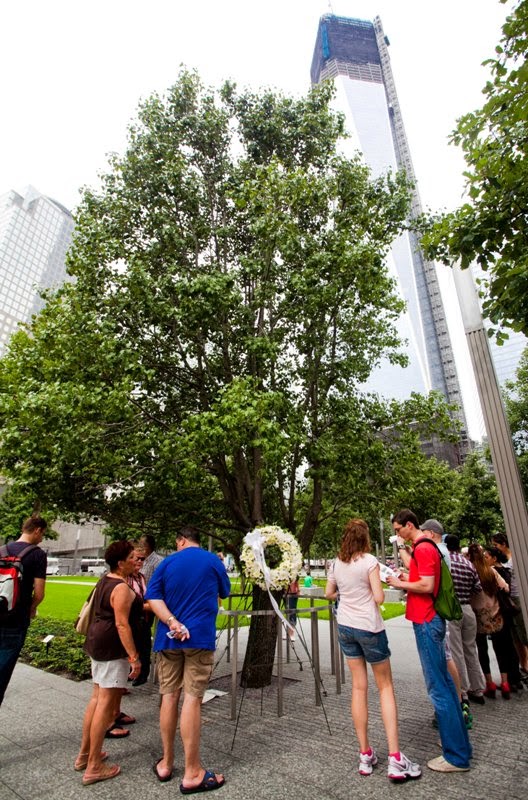
After weeks of clearing away the 1.4 million tons of debris from the vicinity of the World Trade Center towers, workers unearthed a living survivor of the horror—a bruised, beaten and burned, 30-year-old callery pear tree.

   It was the last thing to leave Ground Zero alive.

PHOTO: New York City Department of Parks and Recreation

In a long-shot effort to save the mangled tree, a horticulturalist for the Parks Department had it removed and carefully transplanted in a nursery in the Bronx, where it remained in obscurity for nine years. This was not just the only one of many trees on the WTC site not pulverized by the force of the collapses; it was the last thing to leave Ground Zero alive.

Meanwhile, Ronaldo Vega, another city worker and one of the thousands enlisted to help bring equipment and supplies to Ground Zero after the tragedy, reported faithfully to the site every day, doing what he could to help bring closure to the nightmare and honor the memory of its victims.

Vega never missed a day. He was so committed to the site that he eventually was named the 9/11 Memorial’s Director of Design and Construction. As concepts for the Memorial percolated, he heard about the intrepid pear tree, and was immediately smitten by the power of its symbolism. He wanted that tree.

It took Vega six weeks to find out what had happened to it. In March, 2008, he went to the nursery and got his first look at what he now referred to as the Survivor Tree; it was in full bloom. From that moment, the tree would become the focus of his passion for the Ground Zero site, and he vowed it would occupy a prominent spot in the Memorial’s design.

But the challenges weren’t over for the tree. No sooner had Vega seen it flourishing, than it was torn nearly in half by the 100-mile-per-hour winds of a huge nor’easter. Nursed once again back to health, it was finally moved into place on the 9/11 Memorial Plaza in 2010, where, just nine months later, it managed to hold on through Hurricane Irene.

PHOTO: Noel Y.C.

IF IT'S THE LAST THING...
Now, the story of the Survivor Tree is dramatic enough. But that is a matter of cellular biology, phytochemistry and perhaps a bit of luck. What leapt off the screen for me in this documentary was the story of Mr. Vega himself. That, my friends, is a story of heart.

Though it’s difficult to find much written about Vega’s personal challenges, one can piece together the narrative. As a first responder and a denizen of Ground Zero every day for 13 years, he was exposed to no end of toxic particles and vapors. At 55, he’s got triple the maximum levels of arsenic and mercury in his body, and suffers disease of the liver, lungs, sinuses, blood and skin.

Like so many workers on the site, the exposure is killing Ron Vega. Yet life has never been more fulfilling for him. “There’s certain things you decide in your life what's worth it and what's not worth it. Working at Ground Zero was worth it, was worth it whatever comes," he says.

     The Survivor Tree has the power to steer us        
     to those places of body, mind and spirit where 
     we were always meant to be.

The tree has become the most important part of Vega’s life. He suggests, in one interview, that his devotion to it has supplanted other relationships and responsibili- ties—those of home and family and friends—to the detriment of all. But he is consumed by the depth of meaning this one organism holds for him, how it "speaks to both the horror and the healing" of the tragedy.

I take the significance a step further; the way I’d put it, the Survivor Tree represents the sheer power of Nature to sooth, to heal, and to steer us to those places of body, mind and spirit where we were always meant to be. I suspect Ron Vega's discovered that truth and realizes, as precious few others can, exactly what the journey is worth to him.


PHOTO: Discovery Channel

A TESTAMENT TO LOVE
I’ve not yet been to the 9/11 Memorial, but it looks like the most stunning American monument since Maya Lin's rend-the-earth design for the Vietnam Veterans' Memorial. Its two square waterfalls surround the footprints of the twin towers in whispers of remembrance. Outlining each are bronze parapets engraved with the names of each of the 2,983 victims of the 9/11 attacks.

PHOTO: AP/Mark Lennihan.

These waterfalls and pools represent the voids left in human lives and in the hearts of a city and a nation. And around them stand other powerful symbols of the transformation that so often grows from the grief. One is the spectacular new buildings erected around the memorial site—including the new One World Trade Center, or Freedom Tower, built to exactly 1,776 feet in height. I guess they’re, at the very least, an understandable statement of defiance and pride.

The other symbol, one that holds a softer, yet more powerful, meaning for me, is the 400 swamp white oak and sweetgum trees, harvested in areas surrounding the sites of the three 9/11 crashes. These gifts of Nature also represent the hope and the unshakeable spirit of growth and renewal that define a city, a nation, a people.

And finally, how magnificent that Ronaldo Vega and his indomitable callery pear—the Survivor Tree—are there to represent the nexus of those two realms of remembrance. Theirs is, of all the symbols, perhaps the most powerfully personal and moving testament to the constancy, the splendid beauty, the healing promise of Nature.

For theirs is a testament to love.

PHOTO: Amal Chen/The Epoch Times


Monday, September 15, 2014

WHEN NATURE SPEAKS – Echoes of Eternity

When Nature speaks, it’s for a reason. She's sharing things we need to hear—invitations, affirmations, lessons about truth, beauty, love and life.

While the human animal’s obsessed with how to stretch and bend her to create our own realities, Nature reminds us of one eternal reality, that everything is connected. Everything. That what we might fear in her we actually fear in ourselves. And that what we do to her we do to ourselves and others. 

What a joy our place in her should be, a position that, miraculously, both humbles us when we’re arrogant and ennobles us when we’re feeling unimportant.


BODY AND SOUL
Nature’s voice surrounds us, fills us, every day. She speaks to our minds, showing us immutable truths of how things always grow and move and interact. At the same time, she refreshes those ancient instincts that have always advised us on how to apply those truths. She tries as she can to show us both the portals and the boundaries of our intimacy.

            Only if we love her back will we 
            care enough to protect her as if 
            she were our own flesh and blood.

Sometimes the message is for our bodies, calling us to work with her, run with her, bask in her. She fills us with contentment, with exhilaration, and then reminds us that, while she may seem indefatigable, we are not.

Finally, she speaks to our hearts and our spirits, reminding us of our deep belonging to her. It is an unconditional love, that of the tenderest of gods, yet utterly indifferent to the values we humans have devised for ourselves—and so often fail to exemplify. 
 
WHAT TO SAY BACK
Don’t think for a moment that what Nature has to say to us has to be a monologue. In fact, there are many ways to hold up our end of the conversation. Perhaps the most obvious is through sound.

If we spot a beautiful bird—a cardinal, let’s say—we obviously can’t look like a cardinal; we can’t feel or taste or smell like one either. But we can sound like one. I do it all the time (and the cardinal nearly always comes closer).

When Nature calls us to our child side, we might answer her with playful cries and joyous laughter. Or we can welcome her accompaniment as we shuffle leaves, crunch acorns or splash water.

We can shout or clap our hands and listen as desert ignores, forest ponders or canyon mimics. Or we can offer Nature the one gift we have that might nearly rival birdsong and wolf call—our own voices in song.

                You know it's not really a 
                sound, but still you hear it.

THE SOUNDS OF SILENCE   
Can we converse with Nature through silence? Have you ever experienced true, total silence? I’ve done so only a few times in my life. It leaves an impression. At first your brain doesn’t quite know what to do without the foundation of at least some ambient sound.

It’s kind of like being in total darkness. It makes you dizzy. You can almost feel your ears reaching out, expanding, cupping to detect something, anything, to get a bearing on.

Then, like the way we try to fill the awkward lull in a conversation with an “um-m-m” or an “ah-h-h-h,” Nature comes up with her own space filler, a sort of dull roar. You know it's not really a sound, but still you hear it.

How curious that, while total silence may disorient, near-silence—especially that infused with Nature’s whispers of wind through trees, water over rocks, the jabber and scurry of life—is where, more than any place, you will hear the sound of your own spirit, that reassuring voice that reminds you of your unique part in the oneness of everything.


MISPLACED FEARS
This is an era in which too many of us humans seem to be getting it backwards in our attitude toward Nature. We've come to fear her more than we love her. We keep our young ones indoors where we can keep an eye on them. We discourage them from the kinds of adventures that defined our own childhood, but which we now somehow believe are too risky.

        In her voice are the echoes of everything 
        that ever lived...or ever will live.

If we truly listen, we know that the truth is a different matter. In fact it is Nature that should fear us. Once again, she’s telling us—and we should be listening—how we hurt her through our arrogance, our greed, our short-sightedness and, perhaps most tragically, through those poorly-informed fears.

Nature is as benevolent as she has ever been. And, in this era of virtual experiences and connections, her presence in our daily lives is needed more than ever. Depriving our children of her nurture, her teachings, her healing spirit, is hurting them—and us—in ways we are only now coming to document, and to a degree that far, far outweighs any actual risks.

FLESH AND BLOOD
So keep your ears peeled for Nature’s voice. It’s there, not just in the forest, but in the heart of the city. You can hear it in creatures’ voices, including our own. It comes from growth and movement—the raspy rattle of tree branches rubbing shoulders in the wind; water’s cheery chortle as it charms its way over and around hard rock. Some folks even hear the trees, the clouds, the land.

And only if we listen—truly listen with ears, hearts and souls open—will we learn about Nature and our belonging in her. For in her voice are the echoes of everything that ever lived...or ever will live. Then, only when we know and trust that eternal bond, will we be able to reciprocate her love. Only then will we know enough to protect her as if she were, indeed, our own flesh and blood.


Friday, August 29, 2014

LIFE AS A PALINDROME* – Why We Need Nature Both Coming and Going


My recent work as a hospice volunteer has me thinking more and more about life, and how wonderful it is that the hospice movement, regardless of how quickly or slowly life may wind down, focuses not on the process of dying, but on the process of living until one dies.

The difference may seem subtle, but for hospice patients it is not. One of the reasons I’ve always feared the idea of aging is that, nearly every time I’ve visited
a nursing home, no matter how nice the accoutrements, the residents seem so isolated, so stuck inside those cheesy-art-strewn walls with companions not of their choosing, so unplugged from Nature.

MIRROR IMAGE
Have you heard this comedy shtick—attributed to several sources—about why life really should be lived backwards?
“I think the most unfair thing about life is the way it ends. I mean, life is tough. It takes up a lot of your time. What do you get at the end of it? A death! What’s that, a bonus?
I think the life cycle is all backwards. You should die first, get it out of the way. Then you live in an old age home. You get kicked out when you’re too young, you get a gold watch, you go to work. You work for forty years until you’re young enough to enjoy your retirement!
You go to college, you do drugs, alcohol, you party, you have sex, you get ready for high school. You go to grade school, you become a kid, you play, you have no responsibilities, you become a little baby, you go back into the womb, you spend your last nine months floating…and you finish off as a gleam in somebody’s eye.” **
Isn’t that a wonderful notion? Why can’t life be more like that?

Of course, I can’t help but bring to this reflection my Nature-loving, quasi-pantheist point of view—that we come from Nature and, whether we’re smart enough to stay engaged with her throughout our lives or not, we inevitably go back to Nature.

  We’ve always been here and we always will be.

It's not exactly the scenario laid out in the comedy bit; there, even though that ideal life is reversed, it still has a beginning and an end. The advantage of my truth is that, far beyond our blink-of-an-eye, flesh-and-blood presence here on this blue-
green pinprick of light in the deep black fabric of the cosmos, we’ve always been here and we always will be.

As I suggest in my previous post here, The Stuff of Stars – What Every Human Wants—this amounts to nothing less than immortality. Not the fuzzy going-home-to-God-in-heaven version I was brought up with, but one that’s equally positive and, for me at least, considerably easier to believe.

NOT JUST FOR KIDS
These days, as the Children and Nature movement and its “Nature Deficit Disorder” diagnosis of screen-bound kids gain traction around the world, it’s easy to believe that Nature is most essential to human beings when they’re young. After all, they say it’s then—mostly before the age of five—that the essential building blocks of a healthy, happy life are laid down. And Nature is, indeed, a master mason.
 

In the U.S and many other cultures of the “developed” world, we then grow up, we tie ourselves to our work and our homes, and many of us forget what it was like to be one with Nature.

But if we could accept, for a minute, that the end of life is—or should be—the mirror image of its beginning, wouldn’t it make sense that Nature play as big a role in our health and happiness when we’re very old as when we were very young?

Take me outdoors...where Nature can replenish my soul with her perfect, timeless beauty and wisdom.

My hospice training urged us volunteers to bring with us to patient visits a “tool kit” of things to read, pictures to look at, music to listen to, perhaps a few games to play. And, depending on my patients’ particular likes, I will have those things.

But the most important device I will bring is the turning of a door knob. For it is only outdoors where all of one’s senses are brought to life at the same time, where a person whose horizon draws near is reassured, not just of being thoroughly in each moment, but of an essential sense of belonging—today, tomorrow, forever.


COMING HOME
I hope with all my heart that this will be the case for me, that when I’m too feeble to easily get out and use my precious abilities to walk and climb and paddle, someone will be kind enough to lend me those capacities. Take me outdoors, with the animals and plants and moving air, where Nature can replenish my soul with her perfect, timeless beauty and wisdom.

The end of my life may not be, as the quote imagines, the gleam in my parents’ eyes, but I’m convinced I’ll see a much deeper intent, that of a benevolent universe, welcoming home, after his briefest of visits to this earthly life, one of its own.

* The word “palindrome” comes from the Greek
palin dromo, which means “running back again.”

** This bit has been attributed to George Carlin, Woody Allen, and even Andy Rooney, but there’s a pretty convincing case for its actually having been written (and performed on the
Tonight Show with Johnny Carson in the early ’80s) by lesser-known comedian Sean Morey. 

At any rate, I found this a particularly nice version of the life-backwards story, as it is audio-only—allowing one to conjure one’s own imagery. LIVING LIFE BACKWARDS

Tuesday, July 22, 2014

THE WAY OF DECAY – The Eternal Cycle of Death and New Life

My favorite season is barely half done, and already the signs are there. A few impetuous leaves turn red and yellow. Potted plants grow weary, strangled by their own root-bound legs. Sumac's velvety cobs blush, eager for their time, their raison d'être. Summer, devoured slowly by moss and mold, nourishes a new kind of spring.
               Lives end; life endures.


As if to show its still-lustrous, vibrant kin the glory of the eternal cycle, a shed rhubarb leaf uses every device of color, texture, line and form to say There is beauty and fulfillment where I am going too.

Lives end; life endures.

Monday, November 4, 2013

FLOW - Meditation by a River

(When it's my turn to host a meeting of my men's group, I like to offer some kind of calming, centering exercise to help everyone shed the stresses and concerns of the day and be fully present in the here and now. This time, I've been unable to find just what I was looking for...so I wrote my own brief, guided meditation.)


Your life’s wanderings have brought you to a small river. You sit on a large deadfall—oak, perhaps—whose body time has stripped of bark. The dry wood is warmed by late May sun.

Better than silence, the place murmurs with comings and goings of countless living things. You watch life’s drama play out, as if unreeled slowly, frame by frame, by the passing water.

A kingfisher laces the far bank of the river, dipping and rising from one vantage point to the next. The filament of his presence passes from riverine space into that of your soul, seamlessly, and back out again, then slowly out of sight down around the bend.

       You imagine the thoughts and concerns 
       of your day, like these other living things, 
       coming into view.

Just below you, a school of redhorse works the shallows, vacuuming the sandy bottom. You marvel at the interplay between each purposeful individual and the seeming randomness of the group. It, too, swirls slowly past with the current and disappears.

You imagine the thoughts and emotions of your day, like these other living things, coming into view in and over the water. They too fly and swim and pass through, from the unimaginable expanse of the cosmos, into and through the slice of it that is your consciousness, and then back out again to join the eternal flow of life.

You sit there, as aware as one can possibly be of the simple joy of this place of calmness and connection. You glow with gratitude for the fact that your presence, your being, is solid and true, informed, but not defined, by concerns of the mind. You sit…and feel…the smooth, warm wood under your seat.

Friday, August 30, 2013

GREEN – As If for the First Time

WAXING ARTISTIC
When I was a boy, I loved coloring with crayons. There was something about how they looked, those neat little cylinders with their tight paper wrappers and slick, lathe-turned tips. And the way they smelled—it still takes me back to those purer, simpler days.

Most of all, I loved the colors, those waxy, translucent hues that seemed to channel light through themselves rather than just reflecting it.


            I guess I knew, even then, that this 
            is a world of many greens.

I soon tired of the basic 8-color Crayola sets. Those, I figured, were for little kids who still scribbled across their coloring books. No, I coveted the big 64-color boxes, the ones with neatly stepped tiers of crayons in subtler colors, shades falling in between the basic, primary colors. These were colors worthy of staying within the lines.

What I remember most are the greens—not just plain old green, but the other, more complex, delicious ones: blue green, yellow green, pine green, spring green, olive green and sea green. I don’t know if the other kids cared, but I did. I guess I knew, even then, that this is a world of many greens.

A GLUTTON FOR GREEN 
It's awfully easy to take green for granted. After all, for many human beings—not just those who live in jungles, but us who live in places where grassy lawns and lush, deciduous trees are valued—the color is everywhere.

Just this morning, as I drove to my office, I conducted a little experiment. I took a series of virtual snapshots of my vistas from the car. Then I calculated the percentage of each image that was green. Incredibly, it ranged from about 30 to nearly 70 percent. There was nowhere I could look where green was not a significant part of the view. And that’s right in the middle of a big city.

With this much of it in sight, no wonder we fail to appreciate green. It's like how people eventually forget about the natural and cultural attractions closest to home, ones a tourist wouldn't think of missing.

...from the whispered pastel green of hydrangea blossom to the edgy chartreuse of spring willow.

In that drive to the office this morning, it struck me as never before how that abundance of green pleases my eye and feeds my spirit. It's not just how much there is, but how many delicious flavors it comes in—like my 64-color box of crayons and then some.

From the just-becoming green of leaves’ first unfurling, to the heavy, weary green of late summer. From the deep coolness of those shady recesses between blue spruce boughs to the dusty gray-green of Russian olive. From the whispered pastel green of lichen or hydrangea blossom to the edgy chartreuse of spring willow.


As more and more research is done on the effects of mankind’s increasing disconnect with Nature, studies are showing that proximity to green foliage—even if it’s only in the view out your window—has a measurable, positive effect on your level of stress, your state of well-being, even your productivity.

         Imagine how it would be to wake 
         up one morning and find it all gone.

THE COLOR OF LIFE
So why does green affect us this way? Is it because it represents everything that grows and nourishes us? Might we associate it with the amazing symbiosis between animals and plants where each depends on what the other exhales? Does it remind us of the African landscape where our very humanity was born? 

I suspect very few folks stop to appreciate the incredible scope and range of greens that decorate their daily comings and goings. It’s a bit easier for those of us in northern climes, who lose most of our green for about five months of the year. We know what we’re missing. So do people who live in desert or semi-arid places where greens are scarce and short-lived.


So, even if you’re blessed with year-round green, take a moment to imagine how it would be to wake up one morning and find it all gone. Start right now, with what you can see from where you sit. Look around; look out the window. Make a point of noticing this verdant color of life in all its many tones and textures.

What are your favorite greens? How does green make you feel? Have you ever lived in a place where you felt starved of those feelings?


Thursday, June 13, 2013

AS IF FOR THE FIRST TIME – Sun

It was a very long winter here in southeastern Minnesota. It takes a certain kind
of internal strength—some might call it insanity—to weather those five months
of short, too-often-gray days. Now, spring’s crept in tentatively…and seems
reluctant to leave.

It seems like just a few weeks ago that it finally hit me, even if the air wouldn’t yet admit it, that we were finally out of the gray winter woods. That day, I brushed my arm against the black wrought iron frame of a bench I was sitting on and nearly burned myself.

You can see why, around here, we might take the sun less for granted than most.

Few of us have ever experienced more than 
a few days without the company of shadows.

CAN’T STUMP WONDERMAN
Like so many of Nature’s omnipresent wonders—like water, trees and air—even if it sometimes seems in short supply, the sun is still awfully easy to disregard. After all, few of us have ever experienced more than a few consecutive days without the company of shadows, not to mention natural warmth, light and all the sun’s other gifts. In fact, the sun’s so integral to life on earth, that its absence is utterly unthinkable.

That familiarity, no matter how we might try to fight it, breeds apathy. Like food
or water, unless we were to experience life without the sun, none of us can ever
fully appreciate its wonder. But hey, do you think that will keep this WonderMan from trying?


WHAT’S THAT STRANGE GLOW?
So how often do you think about the sun? Can you imagine how it might look and feel if you’d never experienced it before? If all the ambient warmth, light and plant-growing energy you’d ever felt had been somehow man-made?

It turns my skin darker, but has 
the opposite effect on my hair.

Here are just a few of the reflections I can imagine one might have on the wondrous novelty of natural sunlight, seen for the first time:
  • How can anything so small—it takes up only about .0005 percent of the sky—be so bright, so warm, so all-enveloping?
  • That tiny orb’s glow heats things it lands on, but not the air it passes through on the way. (Kind of like how your microwave heats your cocoa but not the mug.)
  • When I face it with my eyes closed, it turns my eyelids into fiery orange lighting gels (a perfect background to show off my little, black, stringy eye floaters).
  • It moves across the sky all day and then, apparently, sleeps somewhere at night.


  • Just after turning in, its glow lasts a while, turning clouds amazing shades of pink and orange.
  • It seems to do something to my plants that grow lights can’t—like they’re on steroids or something.
  • It turns my skin darker, but has the opposite effect on my hair.
  • The thing’s so powerful that if I let it shine on me for an hour it burns my skin.
  • It uses the spaces between trees’ leaves like lenses, focusing its light into so many circular pools, like thousands of tiny spotlights.

Can you imagine experiencing natural sunlight for the very first time? Could you see it the way a five-year-old would? What observations might you have?

Friday, October 19, 2012

WHISPERS OF LEAVES – Heeding the Wisdom of Autumn

How one defines the seasons of one's life is pretty arbitrary. Take fall for example.
I know some 50-somethings who act like they’re already anticipating the end, fading and molding away. And I know a few 80-somethings who still wake up every day expecting change and growth, celebrating life by donning their brightest colors. (I like that quote by baseball icon Satchel Paige, “How old would you be if you didn’t know how old you are?”)

Nonetheless, each of us reaches a certain age where it’s hard not to realize that there’s more of your life behind you than ahead.

 
      I may not be as fresh and flashy as I was
      in my spring…but my roots have grown deep.
      I know who and where I am.


DIVERGING PARALLELS
Just the other day, as I shuffled through some whispering leaves, I was musing on these parallels between this stage of life and this season of the year, and how many of them really apply to me.

Clearly, at least by the measure of years, I’m well into the autumn of my life. And, sure enough, a few of my leaves are withering and dropping.

I may not be as fresh and flashy as I was in my spring, as cocksure as in summer, but a few fires, droughts and storms have sent my roots deep, made me strong. I know who and where I am. You could say I'm just starting to show my best and truest colors.

As autumn comes, at least up here in the North Country, life heads indoors. Sap slows, animals settle into cozy burrows and dens; people, into their homes.


Isn’t that what’s supposed to happen in life too? Like they say, don’t our creative juices, our vitality and engagement with the world around us start retreating in our autumn? More and more, as our physical reach diminishes, shouldn’t our lives
turn inward?

This is where the parallels start to diverge for me.

        I want my experience, my knowledge,
        to be like blocks of granite…spread out
        before me, a row of stepping stones to
        more and deeper truths.


STEPPING STONES
No one doubts that the autumn of the year will yield to winter and then, inevitably, to yet another spring. The autumn of one’s life, by most accounts, will not. I’m not sure I can accept that as graciously as a tree, a bear—or a snowbound Minnesotan—accepts its annual four- or five-month dormancy.

I want my experience, my knowledge, to be like blocks of granite, not simply piled up as the foundation of my awareness and ego—or perhaps as a monument to them—but spread out before me, a row of stepping stones to more and deeper truths—about myself and about the cosmos.


If there’s a tendency to think of the fall season as an ending, a winding down,
isn’t it also a beginning? Isn’t it the start of a process of storing, building, putting by the provisions for the long cold winter, and collecting fuel for the inexorable engine of spring?

That’s the way I’d like to see the autumn of my life too. Not giving up, not letting go, but building toward something new, something deliciously unexpected. I don’t know what that might be, but I’ll look forward to it nonetheless.

    Do we really get just one of each life season?

I guess that’s where faith comes in. Of course, no one can prove that some level
of consciousness carries on after the human body’s demise…but neither can
they prove that it doesn’t. That’s the beauty of it; we can choose which reality
to embrace.

So, what do you think? Does the human life / seasons of the year metaphor work for you, comparing one’s lifetime with just one astronomical year? Do we really get just one of each life season? Can’t someone like me, in the fall of his life, embrace that season for all its melancholy reality and still look forward to another spring?

Can’t we always believe in the promise of spring, if not in body, at least in spirit; if not within the power of Nature, perhaps within some inscrutable power of our own?

I don’t know about you, but I live for that promise.

Saturday, September 1, 2012

EVENING GLORY – The Other Side of Now

I've always loved morning glories. The way they greet each new day with all their being, expending their most joyous color early, fading in afternoon's heat, then closing down, passing their lifeblood of light to other buds whose day is tomorrow.

I've marveled at that one continuous parasol petal, a fabric of such gossamer translucence that it must be lit from within.

And then there's that breathtaking color—blue's my favorite, a clearer, truer blue than that of any bloom.


But this evening I stop and appreciate the plant's evening glory. Here, in one
gaze, are both its coming and going, evidence that one's not simply the inverse
of the other.

No, morning glory unfurls radially, like a twirled umbrella, but curls up another way, rolling in and over itself like water down a round hole. It will not open again.

The irony's not lost on this wonderer that, so unlike me, this moment's all about past and future. I'm glad that, come morning, now will once again unfurl.

Saturday, August 18, 2012

HOW TO BE IN THE MOMENT – 101 Tips

TIP #10 
Feel the pulse of a hot summer meadow.


Late summer afternoons, the meadow is a shrill cacophony, a population of buzzing, whining, whirring beings.

And, like any city, this one emits one common, unifying sound, a kind of pulsing, sizzling energy. Can you hear it in the meadow, this heartbeat of life?

Tuesday, June 26, 2012

HOW TO BE IN THE MOMENT – 101 Little Tips

TIP #28 
Garden.


We come from the earth, and there we return. Gardening celebrates this elemental connection in a most wondrous, reciprocal way.

Growth, flowering, fruiting—it’s all shared, not least the nourishment. The potential, you see, lies in the gardener as much as the seed.

Wednesday, May 2, 2012

INTERLUDES – What Mexicans Have Taught Me About Patience

Life is what happens to you while you’re busy making other plans.
JOHN LENNON – "Beautiful Boy"

One of the many things I admire about Mexican culture (at least in parts of the country I’ve visited) is the way people savor life—not life shaped to their ends, but simply life as it is.

For generations Mexicans have gotten a bad rap for being slow, unreliable and lazy. While I know from much experience that this is far from an accurate characterization, I can see how an ignorant person might get that impression.

It’s a responsibility to things on which a norteamericano or an europeo might not 
place as high a value.

Mexicans don’t let plans, schedules or clocks run their lives. This isn’t because they’re inconsiderate or irresponsible; they aren’t. In fact, it’s often because they are so responsible that Mexicans refuse to be bridled by time. But it’s a responsibility to things on which a norteamericano or an europeo might not place as high a value—especially their commitment to family and community, and their unfailing graciousness.

SIMPLE PLEASURES
Mexicans know how to appreciate the simple little wonders that life presents while others might be busy making other plans.

One telling—and typical—experience with this occurred some years ago when I, two of my fellow Spanish students and my compadre Silverio were visiting the home of Silverio’s old friends, Ignacio, Marta and their three daughters in Tlalnepantla, a northern suburb of Mexico City.


Mexicans know how to appreciate the simple little wonders that life presents while others might be busy making other plans. 

They were going to join us for dinner and what promised to be an all-night affair sampling the scores of mariachi bands strutting their stuff in the big city’s infamous Garibaldi Square. We arrived at their house at about 8:00 PM. I thought we'd be in a bit of a hurry, since we’d planned to leave for the restaurant by about 9:00.

After hugs all around, I presented our hosts with the customary regalito—little gift—a bottle of maple syrup I’d brought from home. (On a previous trip I’d given them another taste of Minnesota exotica, a little ceramic moose.)

ONE KERNEL AT A TIME
We sat around the dining room table. Nacho offered us the obligatory tequila, poured from the fanciest of four or five bottles prominently arrayed on the overwrought bar—obviously his pride and joy. When Marta asked if anyone wanted popcorn, the hands of Brenda, Andrea and Abril shot up in the air, making it unanimous.

A few minutes later Marta emerged from the kitchen carrying nine paper napkins and one small, steaming bag of microwave popcorn. We all helped ourselves to our share, just about a handful each, which we piled on our napkins.


One precious kernel at a time, they’d hold it up, inspect it and finally place it in their mouths.

As we chatted, I watched the little girls quietly savor that popcorn. It was as if it were the last popcorn they’d ever see. One precious kernel at a time, they’d hold it up, inspect it and finally place it in their mouths. They made those few buttery morsels last for about fifteen minutes.

PRECIOUS MEMORIES
I got up to stretch my legs, taking a closer look at some of their prints and knick-knacks. Nestled in the corner of the living room was a small glass étagère with three or four shelves. On each were five or six little souvenir items from places the family had been to or dreamt of going to: a baby spoon engraved with the name of some amusement park; a shot glass from a resort area near Guanajuato; a plastic replica of the Statue of Liberty. And there, front and center on the top shelf, was my moose.

By this time, everyone else had joined me around the curios. For the next half hour, we all stood there admiring those three- or four-dollar items, listening to the girls recalling each trip, hearing all about the people who’d sent them this keepsake or that. At times, I felt a bit uncomfortable with the lengthy silences, no one uttering a word except for a few contemplative “Hm-m-ms” or "Uh-huhs."

Many of us north of the border strive too much, 
brag too much and admire too little.

SILENCE IS GOLDEN
Do you think that here in the United States this scene would have played out the same way? First, wouldn't the mementos would have been more expensive by a factor of a hundred? But that’s not the point. Even if they're Faberges and Hummels, we’re not exactly famous for our attention spans. Don't you think that, the first time there was a lull of more than a few seconds, someone would have jumped at the chance to go do something more exciting?

Many of us north of the border strive too much, brag too much and admire too little. Silences make us nervous. I’ve tried to adopt a bit of the Mexicans’ patience, their appreciation of little things, their comfort with quiet, thoughtful interludes in conversation, and their knack for being in the moment.

All these gifts, it seems to me, lend themselves very well to our relationships, not just with other human beings, but with ourselves, with Nature and with whatever it is we find sacred.