Showing posts with label architecture. Show all posts

Thursday, July 16, 2026

BIRD’S-EYE PEE-EW – The Sad Decline of Balconies

As a designer and former architecture student, I despise the plague of cheap, soulless apartment and condo buildings popping up around town in recent years. Especially here in the neighborhoods surrounding the University of Minnesota’s sprawling Minneapolis campus.

Most are dull, three- to twenty-story cuboids clad in various colors of stamped metal siding. (As if color could mask the lack of imagination.) With little dimen-
sion, detailing or texture, they appear to have been built on the cheap for a shelf 
life of about ten years.

HANGING BY A THREAD
As if to double down on the shallow design, the builders—pretty sure they’re not architects—nearly always tack on a bristling of tiny, barely-closet-size balconies. Underscoring the tackiness, they opt not to even try integrating them into the building’s structure. 

Instead, they’re more or less screwed into the façade, where it seems the only thing keeping them from simply falling off under their own weight is a pair of half-inch cables. I'm sure the wires are up to the job, but they don’t look like it.


These dime-a-dozen, afterthought balconies are more insult than asset! I wonder if prospective renters or buyers actually see these little appurtenances as an attraction—one that probably added a couple hundred bucks to their payments. 

             These “McBalconies” always look 
             more like swings than solid ledges.


CANTILEVER…OR CAN THEY?
More damning than my esthetic gripe is the fact that very few residents even use these bitty balconies. If I scan twenty of them—say on one of these fine summer evenings—I’d be surprised to spot one of them occupied. Few have as much as a folding chair on them.

No wonder. The thin, woven strands holding up all these “McBalconies” make them look more like swings than solid ledges.

NOW THAT’S A BALCONY 
A thoughtful, well-designed balcony, one you’d actually want to use, is a wonder, especially for those without the space, or with too much altitude, for a deck. It affords one a chance to step outdoors now and then, breathe some fresh air, maybe catch some rays. What’s more, you get a bird’s-eye view.

A balcony should at least provide enough room for a couple of chairs and a small table. Room not simply to sit, but to stretch your legs out without them poking through the railing. Even better, space for a few potted plants, perhaps a bird feeder, and—codes permitting—a small grill.


Besides the issue of space, there’s also an esthetic baseline here; a deck has to look solid, as if it’s actually incorporated into the structure of the building, not just glued on. It’s that visual integrity, that intentionality, that makes a decent balcony feel solid and safe.
   It’s a bonus when your balcony’s made of wood.


Though rare these days, it’s a pleasant bonus when your balcony’s made of wood. I know it can be a maintenance issue, but it’s a warmer vibe—kind of like the feel of sitting in a wood canoe instead of one stamped out of cold, hard aluminum or some synthetic supermaterial.


          Nature blesses us with a vital spiritual 
          connection to Mother Earth.

 
ENTREE TO THE REALM

We human animals have a primeval need for secure, elevated vantage points. That need, once driven by the sheer will to survive, eventually gave way—once we gained the luxury of leisure—to simply a desire to enjoy a few of Nature’s won-
ders, even when living in the city.

We all, especially children, need regular doses of what author and Children and Nature Network co-founder, Richard Louv calls Vitamin N (Nature). It calms us, cures us, and blesses many of us with a vital spiritual connection to Mother Earth. A good balcony offers us at least a maintenance dose.

But we’ve been steadily losing touch with Nature since the Industrial Revolution. And never at the staggering rate that’s come with the Digital Age. The Internet, social media and artificial intelligence have all taken ravenous bites out of that essential connection. Bad balconies don’t help.

While I feel sorry for a kid who doesn’t have a back yard to play on, or an adult who’s too busy to spend much time outdoors, thank God there are still ways to experience Nature in an urban setting. A walk, a bike ride, container gardening…all offer us entrée to that precious realm. 

So does a good, solid balcony.

PHOTO: iStock

Saturday, April 1, 2023

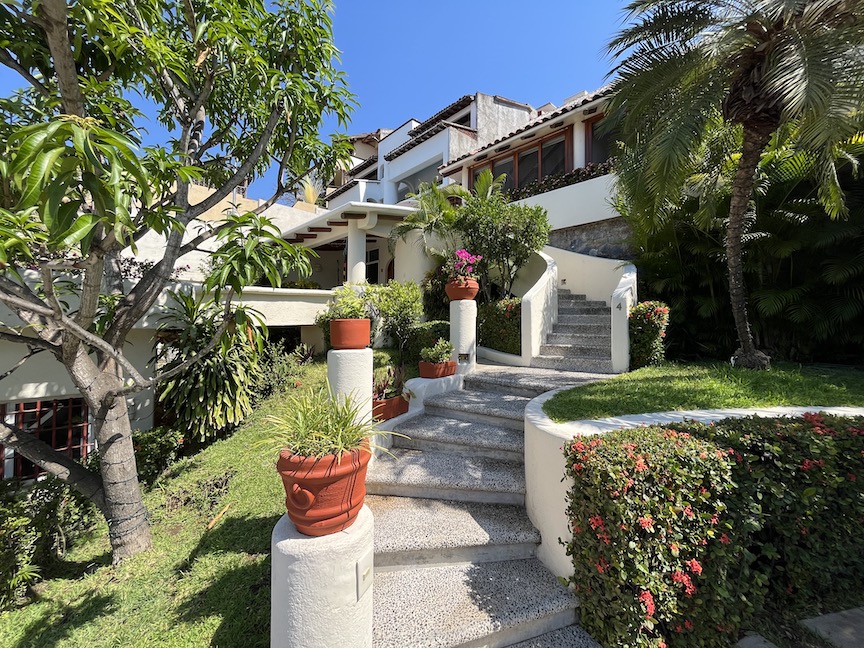
THROWN BY A CURVE – The Fluid Architecture of Villas San Sebastian

As anyone who reads my blogs or Facebook posts knows, Sally and I have a thing for Zihuatanejo, Guerrero, Mexico. We’ve been coming here annually—but for a COVID break—for fifteen years now.

We love the reliably warm, sunny climate this time of year—a brief, but spectacular respite from the last month of winter back home. We love the colors, the flavors, the language and the kind, gracious, hardworking people who live here.

And we love Villas San Sebastian (VSS), our home away from home every March, and where we’ve lodged many of our loved ones when they’ve visited. Our hosts all these years, Luis Valle Rodriguez and his lovely wife Marissa, have become our dear friends.


IXTAPA IT'S NOT
As vital as the personal relationships are, they aren’t the only reason we find VSS so appealing. There’s also the architecture, the physical and esthetic character of the place.

It’s the way these buildings respect and celebrate their breathtaking natural surroundings. All open on at least one side, the villas seem to invite the embrace
of Nature—the sounds and smells, the mild Pacific breezes, the spectacular view
of Zihuatanejo Bay.

It could not look or feel more different from most of the accommodations in Zihua’s neighbor up the road, Ixtapa, with its rampart of high-rise hotels.


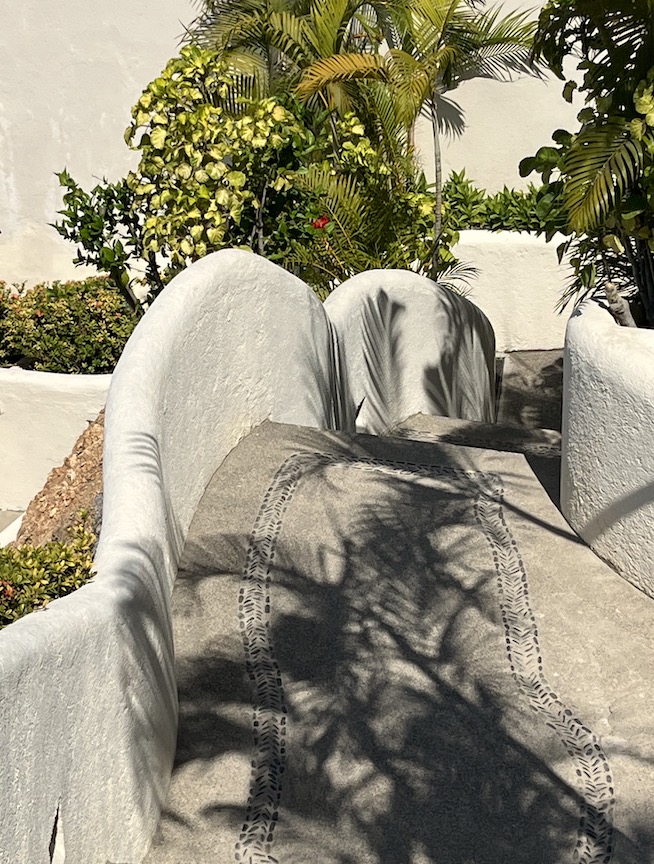
           It’s really hard to find a sharp, right-
           angle corner or edge in whole place.


HUMAN SCALE
While many of the higher-end boutique hotels that dot the perimeter of Zihua Bay are doused in gold, salmon, sage, even purple, VSS is not especially colorful; in fact, but for the plantings and some beautiful, decorative tiled floors, everything here is white and off-white.

If some buildings make their statement with massive shapes or vibrant color, this complex makes it with form and line and proportion.

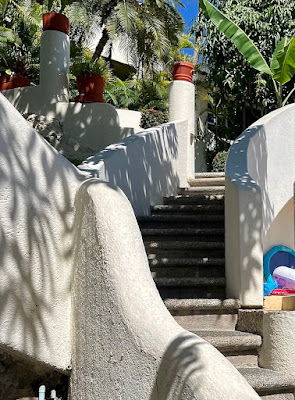
The word “organic” gets used to death, but that’s exactly what this architecture is.  It’s the comfortable, human scale of the place, the way the villas, each with its own unique layout, stair-step up the steep side of the cerro. Connected by winding stairways and sculpted half-walls, each space flows gracefully into the next.   

And the details. Everything’s built in as if part of a single work of sculptured stone—counters, sofas, planters, even beds. And nearly everything is curved. I mean it’s really hard to find a sharp, right-angle corner or edge in this whole place. Even stair edges are beautifully rounded off.

 
          The place...is so graceful, yet grounded,
          so comfortable to both the eye and spirit.


A COOPERATIVE EFFORT
Owner Valle describes this style as a blend, but it's primarily what’s known as Santa Fe style. Starting with what was originally a very old house, Valle, working with acclaimed architect Carlos Desormeaux, created VSS’s first two villas, with the first guests arriving in 1993. 

Several other architects, including Hector Palacios, Javier Renteria and Jose Luis Rodriguez have contributed over the years to the gradual addition of ten more units. (And more, including more amenities, are in the works.)

But Valle is quick to point out that the design process has been truly a cooperative effort, one fueled by his own aesthetic as well as contributions from his wife, Marissa, and key staff members.

There are many qualities that make Villas San Sebastian so appealing: its location, its management and employees, the thoughtful, unobtrusive service. I would keep coming back for those assets alone.

But what really sets the place apart for me is the esthetics. So graceful, yet grounded, so comfortable to both the eye and spirit. (And such a good workout climbing down and up some 90 steps to our villa number nine—near the top of the stack—at least once each day.)  

There are certainly trendier, more luxurious places to stay in Zihuatanejo. But, from our first booking at Villas San Sebastian in 2008, this warm, luscious, highly traditional architecture has captivated us.

Thursday, January 15, 2015

OFF COLOR - Dirty Words About a Gray Minnesota Winter

I’ve been trying to be more appreciative. Too often, I find my view of the here-and-now obscured by inconsequential thoughts and concerns, or just the mindlessness of rote behavior. So, instead of that mental to-do list held up in front of my mind’s eye, instead of that subconscious autopilot that so often steers my motions, I’m changing the script.

I seize on something that catches my eye—or ear…or nose—and, while holding off competing thoughts, very deliberately think about its wondrous qualities. It’s a little like focusing on one’s breathing while settling into a meditation.

 This building has a nice patch of red, which this 
 morning, against a precious robin’s-egg-blue sky, 
 I decided to take as a gift.

CLEARING THE FOG
This morning it was a building, just an ordinary building, one of the scores of new luxury apartment and condo buildings popping up here around the University of Minnesota East Bank campus over the past few years.

Most of these structures—in fact, most of the buildings in our part of the country—are quite obviously designed for gain over grace, doing little, esthetically, but take up space. But this one has a couple of nice patches of red, which this morning, against a precious robin’s-egg-blue sky, I decided to take as a gift.

PHOTO: Metro Park East Apartments

I treasuring the gift for a few seconds, imagining I’d just experienced color for the first time. For that brief interval, I’d managed to clear away the fog of busy-ness and appreciate that color—that clear, intense cardinal red—as the miracle it is.

What a wonder that color exists at all, its raison d'être solely the fact that most of us creatures with eyes can see it, perhaps draw some meaning from it and, if we’re lucky enough to be human, describe it.

NOT ALL WHO HAVE EYES...
Contrary to popular myth, nearly every species of animal can distinguish some degree of color variation. Even most nocturnal creatures (including dogs and cats—categorized as such for their original waking/sleeping cycles) can make out some colors, though far fewer than we humans and other diurnal animals.

But there do exist a very few animals, including some nocturnal rodents, most sharks and a related fish called a skate, which most marine biologists believe see only in shades of gray. (These animals might just love Minnesota’s more typical ashen winter days!)

There are some human beings who can’t see colors. I guess you could say it’s fortunate that the vast majority of these monochromats are born with the condition. Imagine being robbed of color after you’ve already experienced it.

Anyway, just knowing this—that not everyone enjoys the wonder of color—makes me notice and appreciate it even more. I’ve touched on this often in my writings, sometimes analogizing color to a kind of rich, savory food that nourishes my eyes, my heart and my spirit.

      By 4:30 we just hunker down and live 
      with the pangs of our deprivation.

TAKE A TEAL AND A MAGENTA AND CALL ME IN THE MORNING
Here in east central Minnesota, my wife and I feel the hunger building each year by late November. Trees denuded, shriveled to gray stick figures; grass sapped of green, then smothered in white. And it just gets worse. By mid-December any thin wash of color that does remain gets swallowed in darkness by 4:30. We just hunker down and live with the pangs of our deprivation.


(Yes, I’ve been known to preach here about how much color there is to be found in our winter landscapes if one really looks. (The Colors We Bring) But, truth be told, we just get weary of having to try so hard.) 

PHOTO: WSAW News, Wasau WI
We know there are nutritionists who'd prescribe a diet of southern California or Florida for what ails us, but we don’t trust them. Not enough quality control in the kitchens that fix this fare; too often it loses its potency to some tropical depression or continental-scale polar vortex.

No, we’ve found the best, most reliable color diet in Mexico—specifically, in Zihuatanejo, Guerrero, on the Pacific coast just north of Acapulco. There, the color is fresh off the tree, still warm from the sunny vineyard. Leaves stay green and flowers bloom all the time.


Folks in Mexico aren’t content with a little dab of red on a building. They paint their houses colors that would be, you know, frowned on in Minnesota. When you think of it, all they're doing is mirroring Nature. The sea, the critters, the plants, the arts and crafts, people's skin…oh, and yes, the food, all feed us, sustain us with their colors.

Every precious day we’re there in Zihuatanejo we watch it, walk through it, bathe in it, just sit there in awe of it. We eat it up...and then keep going back for seconds.

Thursday, February 24, 2011

Snapshots from Zihuatanejo - Lime Bisque

Mexican architecture loves dense, delicious color. In this detail, though, one savors the color for its understatement, a tart slice or two of lime surprising and delighting in a creamy bisque of shadow white.