Showing posts with label wilderness. Show all posts

Monday, August 26, 2024

LAST PORTAGE – A Tribute to the Father I Never Knew

As a teenager I, like most adolescents, believed my parents were total nerds. Knew nothing, I thought, about music, sports, adventure, fun—all the stuff I was into. They were so…well…old, that they embarrassed me.

But as they aged, my dad started sorting through his mementos, and when he showed me some of them it opened up a whole new window on his world. Among those relics were a few small black-and-white pictures of him canoeing with his friend, Bob Clough, in Minnesota’s north woods. They looked to be in their late teens or early twenties, young and fit and happy. I was intrigued.

          This made us not just cool kid
          and dorky father, but kindred spirits.


There were also receipts from outfitters in Ely and Winton, Minnesota, towns near entry points to the Boundary Waters Canoe Area Wilderness (BWCAW).* They listed flour, sugar, lard and various canned goods,** all in quantities sufficient for extended stays in the wilderness.


And there was this map, printed on treated canvas, of a portion of Ontario’s Quetico Provincial Park, the BWCAW’s even wilder counterpart across the border in Ontario. Hand-drawn on it was a new portage the two had blazed across the base of a long peninsula, cutting off a couple of hours’ paddling time around it. They’d tentatively claimed it on the map with a red arrow and their last initials, C&W.

KINDRED SPIRITS
I’d known Dad was a Boy Scout, but this was something else, something more exciting than good deeds and merit badges. The guy had roughed it on his own terms, for weeks at a time, in true wilderness, back when that word meant more than it does now. A real man’s man. And, since I’d also done many BWCAW and Quetico trips myself, this made us not just cool kid and dorky father, but kindred spirits.

Fast forward to 1997. Dad was 91; I was 52. And that July Dad passed away. Even though Mom was still living, I felt like an orphan. I regretted not having known him better. But finally being aware of that adventurous, woodsman side of his was still pretty special.

When it came time for the family to divvy up Dad’s stuff, I didn’t want much. But I wanted that map. And I got it.

That old cloth map stirred something in me. And during the following year I began planning a canoe trip up to that portage. I invited six friends with varying degrees of wilderness paddling experience who I thought would most appreciate the adventure. We put our heads together to plan logistics: dates, route, menu, equipment… And I created graphics and mementos for The Memorial Expedition—a six-inch round commemorative plaque and a dozen three-inch souvenir medallions—and had the design sand-etched onto clear glass blanks.


          The miracle material can stop a bullet
          or just about any other impact, but,
          incredibly, is helpless against abrasion.


GETTING THERE
On June second, 1998, we headed north for the five-and-a-half-hour drive to Lake Superior's North Shore, the Gunflint Trail and Tuscarora Lodge, where we’d arranged to bunk for the night and rent canoes for the trip. When we left home, temperatures had been summer-like, with predicted highs in the mid-80s. It looked like the warm streak would apply to northwestern Minnesota too, and hold for at least several days. That was good to know, as it allowed me to pack fairly light, always an advantage for a wilderness canoe trip.

Alas, that night, on a cot barely fit for a prisoner, it soon became clear I’d been grossly misled about the weather. With no heat in the bunkhouse, the near-freezing chill easily breached its walls and my flimsy, ultra-light sleeping bag, making for a miserable night.

Next morning, we were introduced to our two slick, translucent, super-light Kevlar canoes. I learned that this miracle material—originally developed by Dupont as a replacement for the five-times-heavier steel belts used in racing tires, and later as the basis of bulletproof body armor—can stop a bullet or just about any other impact, but, incredibly, is helpless against abrasion.

All this to explain why our host applied a strip of silver duct tape along each canoe’s keel at the bow. If we returned the craft with any part of that tape worn through, we’d be charged a penalty. No problem, considering several of us had long ago learned that a canoe’s bow must never, ever touch anything but water or air.

THE TWO SAGS
They loaded up our gear, Carl’s beautiful wood-and-fiberglass Old Town Canadienne and the two canoes we’d rented, and drove us up to the end of the Gunflint Trail. There we put in at the tip of the long, narrow south arm of Lake Saganaga, one of the BWCAW’s biggest and prettiest glacier-scoured lakes.


We paddled a couple of miles north up the narrow, river-like channel and then into the huge expanse of Big Sag itself.

Then it was west for about six miles across the widest part of Saganaga, skirting its numerous islands and crossing the international border. Once we entered Cache Bay, we had to register with Canadian Customs, letting them know where we were headed and for how many days.

As we paddled away from the rangers’ island, the wind picked up and it started to snow—something I’d only once before encountered up here in June. Luckily, paddling into the wind generated enough body heat to stay quite comfortable…for a while. But soon, the piercing cold was conspiring with high winds and some nasty two-foot waves to deny us much headway, so we found a good landing spot on the lee side of a small island, and built a fire.

The wind kept pounding us for the next couple of hours until, finally, we were able to make a run for it to the nearest decent campsite.

      I thought of all the millions of footsteps
      that have followed in theirs over 75 years.


At the time, officially-designated campsites in the Quetico weren’t shown on the Fisher maps, so we scouted our own site and, hurried by pending nightfall, quickly reacquainted ourselves with the various roles and tasks it takes to set up camp, prepare a meal and protect our food pack from bears.

I shared a tent with my brother-in-law, Carl. Thank goodness neither of us is a super-loud snorer. Nonetheless, it proved to be another long, miserable night, for, once again, the temperature kept dropping, this time to well below freezing.

My nearly see-through sleeping bag, with its scant one inch of loft and a rating for about 50 degrees, came up short—or should I say thin—for me, even wearing every stitch of clothing I had. At dawn’s first scant light, still shivering in fetal position, I looked enviously over at Carl, tucked in his brand new LL Bean, five-inch-thick, zero-degree-rated goose down sleeping bag, blissfully sawing wood. It was all I could do not to either crawl in there with him…or punch him!

Next morning, we had breakfast and broke camp rather leisurely, and then paddled west toward Silver Falls, where we made several small portages before entering the very southeastern tip of the narrow, twelve-mile-long Lake Saganagons*** (Indeed, its name is that similar to Saganaga’s.)

ETCHED IN STONE AND GLASS
About three miles up the north side of Saganagons, we scoured the irregular shoreline for the legendary portage. In the Quetico, portages are not clearly marked with Forest Service signs as they are in the BWCAW. So it took a while, but we finally spotted it, tucked behind a point that we'd mistaken for an island. At last, this was it. I felt we'd accomplished at least the physical and logistical part of our mission.

And then there was the spiritual part. I’ve always been a sucker for all things mystical, especially if they involve ceremony. I felt an immediate reverence for this place we were about to consecrate, picturing my dad and his friend standing there, dirty and exhausted, celebrating their success slogging their way across to the other side of the peninsula. And I thought of all the millions of footsteps that have followed in theirs over 75 years.


We paused for trail lunch**** before starting out across the 52-rod—about 285 yards—trail.

I dug out the small packet of Dad’s ashes I’d filched from the plastic-lined boxful we got from the crematorium. As we slowly retraced my father’s steps, I scattered the sacred dust here and there, saving some to anoint the lake on the other side. And I handed each member of the expedition one of the commemorative glass medallions as a keepsake.

I’ve filed a detailed description of the plaque's and medallions' burial site with my will.

As we walked back, I scouted the surroundings for the best place to bury the glass plaque and the remaining six medallions. I spotted a rock outcrop with a distinctive, linear groove. Following that line down to the point where it receded beneath the soil, I measured off a few feet past that and dug a hole in the spongy, peat-like earth. And there I carefully laid the mementos, along with the last of Dad's ashes.

After I solemnly replaced and tamped down the soil, we gathered on the trail. There was no question that Dad was present. Those who felt the inclination offered heartfelt reflections about him and about the extraordinary experience we were sharing. Some read or recited poems; others simply offered their memories of Dad. I shared one of my favorite T.S. Eliot quotes from his Four Quartets:
“We shall not cease from exploration, and the end of all our exploring will be to arrive where we started and know the place for the first time.”
We made camp that night on a lovely island not far from the portage, and laid over there for one more day before heading back home.


Our paddle back across the border was much more tranquil than the one getting to Saganagons—and no snow this time. I think we all felt a sense of accomplishment, as 50-somethings, having proved our mettle against the challenges of the wilderness, albeit for just five days.

And I felt I’d done my father proud, acknowledging a part of him I’d barely known, but came to greatly admire and respect. I realize it’s pure romanticism, but I’ve filed a detailed description of the plaque's and medallions' burial site, complete with map and photos, with my will.

My hope is that one of my antecedents—who knows how far into the future—might learn of this tribute through family lore, and mount their own quest to find Oscar Willius’s and Bob Clough’s portage and excavate the buried medallions.

Call me a dreamer; I guess it's in my blood.


* The Boundary Waters Canoe Area Wilderness is a 1,090,000-acre (4,400 km2) wilderness area within the Superior National Forest in northeastern Minnesota (United States) under the administration of the U.S. Forest Service. Its network of glacial lakes, streams and connecting portages provides over 1,200 miles of canoe routes.

** Until cans were outlawed in the BWCAW in 1971, the accepted practice had been to put empties into your fire to burn off their inner coating of shellac, and then sink them in the deepest part of the lake where one presumed they’d eventually rust and disintegrate.

*** Both Saganaga and Saganagons are Ojibwe for something like "lake of many islands."

**** Traditional "trail lunch," formulated for simplicity, packability, freshness without refrigeration and high caloric content, consists of: a chunk of hard salami, a chunk of cheese, a few RyeCrisp crackers, peanut butter and jelly, a handful of raisins, a few squares of Bakers semi-sweet chocolate and a cup of Kool-Aid. More recent interpretations have replaced several of these items with a few handfuls of gorp. Swapping some of these components among trip members is common.

Saturday, December 10, 2022

BANSHEE BRINK – Survival and Serenity On Cross-Country Skis

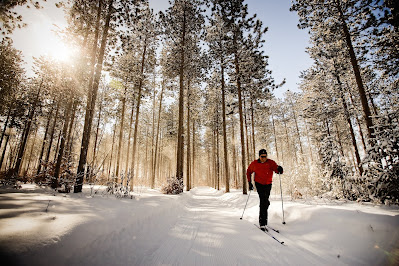
Ah-h-h, the dry, rhythmic whisper of skis on snow. Sh-h-h…sh-h-h….sh-h-h-h-h. An inch of fresh powder last night, and my green wax is spot on—grabs like tank treads going up hills; slick as Teflon going down.

Vivid sun cuts cleanly through fourteen-degree air. In the forest, trees cast pillars of shadow. Snowflakes, awakened by gentle breezes from their naps on high boughs, dust my jacket with glitter.


My body’s working well; I ask the best from every limb, and get it. My hands are already warm enough to shed my gloves. My spirits encourage me, as if skiing just ahead, laying down solid tracks, making it look and feel so easy.

          Before I know it I’m going way too fast
          to slow down.


Through a small clearing I glide, up a long herringbone hill, along a wooded ridge, and finally over the top. Speed picks up slowly; a little poling, faster and faster; now poles can’t keep up; I nearly brush the trees; hope I can stay in the tracks!

Wait! What’s this just ahead…Oh, no, too late! Over a blind crest and Whoa-h-h-h! A roller-coaster hill drops out from under my skis, sending me into near free-fall. Before I know it I’m going way too fast to slow down. Oh my God, I’m dead.

At the bottom a sudden dip catapults me out of the enclosure of the woods and into open sky over a sea of white. It feels like I'm in the air for five slo-mo seconds. I land more or less on my feet, regaining my balance, and then coasting…coasting.

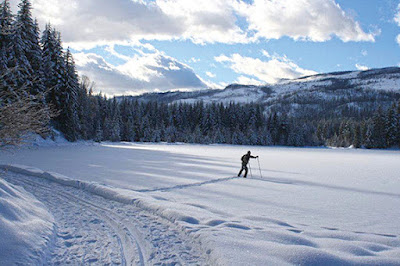
A few easy strides…coasting…and then, far out on the frozen lake, I glide to a stop. I pause to catch my breath and listen. To the brittle silence of winter wilderness. To the still drumming beat of my heart.

(I later find out that I've just survived "Banshee Brink," one of the area's most notorious cross-country ski trail features.)

One’s thoughts are torn at exquisite moments like this. Between the immediate magic and deeper reflection. I’m not very religious, but for some reason, the words of a chapel reading I heard nearly 60 years ago when I was a counselor at a boys’ camp in Maine come to mind:

May the lake, the trees, the wide spaces of the fields and all the nature
 sights and sounds of earth and air be unto us as gates whereby we enter the vast kingdom of thy presence—and think quiet and compelling thoughts.

Saturday, August 18, 2018

ONE SQUARE INCH OF SILENCE – Hearing the Whisper of Nature

The other day I listened to an NPR interview* with Matt Mikkelsen, an audio technician and recording specialist with the nonprofit One Square Inch of Silence.** The organization was founded by Mikkelsen’s mentor, audio ecologist Gordon Hempton.

Mikkelsen points out that, sadly, there are fewer than ten places left in the U.S. where one can spend 15 minutes without hearing a single man-made sound.

IMAGE: U.S. Forest Service

This doesn’t surprise me, and it makes me quite sad.

      He saw that expansive spot of quietude as    
      powerful enough to affect entire ecosystems.

EXPANSIVE QUIETUDE
Tuning in after the piece was well along, I thought at first that the challenge had been to find an area of ground as represented by a square inch on a map. But the real concept may not be that much different.

Hempton felt that if one could find a mere square inch of actual ground where true silence survives, the effect of that tiny locus would surely radiate out for a considerable distance—miles, in fact—all around. He saw that expansive spot of quietude as powerful enough to affect entire ecosystems.

Symbolically, he located one such spot, in the Hoh Rain Forest in Washington's Olympic National Park, and marked it with a single, approximately one-inch stone which he’d painted red.

For the interview, Mikkelsen led writer Samir S. Patel to the spot. As they approached it, Patel wasurged not to speak. He was first to spot the red rock.Then Mikkelsen left him alone in the silence. For an hour. 

And the effect on him was quite amazing. He soaked in the pure beauty all around. He reflected on the recent death of a loved one. He felt both utterly insignificant and all-powerful at the same time. A profound sense of gratitude moved him to tears.

PROFIT AND LOSS
I suppose it takes a certain kind of person to open himself to that kind of affect. For listening is about not just what you hear, but how you hear. Like other kinds of sensing, real listening is an act of generosity.

In this age of constant stimulus, instant gratification and seamless interconnectedness, such moments are indeed rare, and it’s hard to see how they won’t soon vanish entirely from the human experience.

All the more reason to resist the brazen, visionless oligarchy that’s overthrown our great nation—a nation characterized as much by its traditional affinity for wilderness as by its constitution—and is evidently bent on appropriating every inch of public land for private gain.

       My fear turned to a prayer, and I knew
       I was getting reacquainted with my inner 

       strength.

A ROAR OF SILENCE
I encountered my one square inch of silence in Minnesota’s precious Boundary Waters Canoe Area Wilderness about 30 years ago while on a solo canoe trip.

My second night out, I lay in my tent immersed in both total darkness and utter silence. My ears probed, like a sweeping radar dish, for some sound—an insect, a breaking wave, a whisper of air through pine needles, anything. It’s hard to describe if you haven’t experienced it, but the depth of that silence caused my brain to invent a sort of roar.

That deafening void, the sense of alone-ness, was so profound, my mind even stumbled into thoughts of possibly not being able to stand it. I mean was it even safe to be so completely alone?

It took me a few minutes to realize that, as anxious as I may have been to hear the sound of a human voice, its absence had put me in touch with other voices, ones ever fewer of us are privileged to hear any more. My fear turned to a prayer, and I knew I was getting reacquainted with my inner strength.


I awoke the next morning at first light, not sure what it was that had roused me. I was still shrouded in stillness. As my senses tried to get their bearings, I wondered if the eerie noise I was hearing was another imaginary one. A chill rattled me as I realized it was a pack of wolves, awakening with me and musically greeting their day on the other side of the bay.

Would that sound have affected me that way if it hadn’t emerged out of total silence? Would I still have let it feed my inner strength? I don’t think so.

HOW ‘BOUT YOU?
So when was the last time you experienced 15 minutes listening to the unadulterated, calmly-empowering voice of Nature? Has it happened even once? If it has, I’m guessing you remember it well and invite you to share it here.

I also urge you to speak up in protecting those precious gifts a couple of generations of wise and prescient Americans chose to set aside for all future generations: our National Parks,*** where most of the nation's remaining square inches of silence tenuously survive.

* SAMIR PATEL’S NPR PIECE   


** ONE SQUARE INCH  


Sunday, June 26, 2016

BAD DOG! – And Other Things to Say When Training a Bear

With the recent anniversary of the death of my amazing friend, Babak (Armi) Armajani, I’m reminded of the many wilderness canoe trips he and I shared in Minnesota’s Boundary Waters Canoe Area Wilderness (BWCAW) and Ontario’s Quetico Provincial Park. Among our countless adventures, a few provided stories that are especially memorable. This is one of them.

                                                *          *          *

We were several days out on trail, paddling down a long, narrow lake toward our next portage. It was about 4:30—plenty of daylight left, but we always tried to claim a campsite early. According to the map, there were several on this side of the lake, but we’d already seen one other paddling group, so we grabbed the first decent site we came to.

Over the years, the various tasks of setting up camp had settled into a comfortable yet efficient routine for us. Some of us start unpacking tents and cooking gear; others venture out in the forest for firewood; and a couple of guys start looking for the perfect tree from which to hang the food pack overnight, out of reach of bears.

Now, any one of us could have hung the food pack, but Armi, well, this was one of his many specialties; he fancied himself a food pack virtuoso. First off, it had to be just the right tree—the best ones are a ways off from the cooking area and tents, and have one rather isolated, horizontal limb, about 15 above the ground. A rock with a strong rope attached is thrown over the limb at least six feet away from the trunk. One end of the line is tied to the pack; the other end pulled to lift the pack up at least ten feet and then tied off on a nearby tree.

PHOTO: bwca.com

That’s about as far as most folks’ thinking about food pack hanging went. But Armi felt he understood bears; he thought like a bear. So he would ply his art one step further. There had to be a complicated way, after the pack was hoisted, to tie off the rope. Like a special knot; like wrapping it around two adjacent trees instead of the customary one; or adding a dummy rope to cut even the cleverest bear’s chances of untying our pack to 50/50.

While Armi and I perfected the apparatus, our cohorts were busy pitching the tents, cutting and piling the firewood and collecting water from the lake. Before long, our personal gear was in the tents and dinner was on. All was good.

      Someone—or some thing—was emerging 
      from the lake and coming ashore just 25 
      yards from our tents.

ROUND ONE

About an hour after we’d hoisted the food pack and turned in—just as my exhaustion was finally starting to get the better of my discomfort—I heard a curious sound coming from down at the landing. Water splashing…dripping…being noisily shaken off. Someone—or some thing—was emerging from the lake and coming ashore just 25 yards from our tents.

I knew right away it was a bear. A few seconds later I heard it snuffling around over where the food pack was. I felt around for my flashlight and slipped out of the tent as quietly as I could. Armi had beaten me to it. He grabbed the frying pan and a big spoon from the cook kit; I, a mug and a plate; and we ventured out to meet our adversary.


By this time everyone was up and “armed,” right on our heels. The rather large black bear was standing up on its hind legs right under our food pack, intent on smells seeping through the canvas that I’m sure conjured a bear smorgasbord. We unleashed a cacophony of aluminum-on-aluminum percussion, and the 500-pound animal, barely bothered, turned, considered us for a moment, and then ambled back down to the landing and swam away.

            If that bear thought it had gotten 
            the better of us, it didn’t know Armi.

SHOO-SHOO REDUX
Ten minutes later, back in our sleeping bags and just coming down off the adrenaline high, we heard, from the next campsite down the shore a few hundred yards, a familiar dull-metallic clanking and shouts of “Shoo!” and “Hey, get out of here!” We all hoped those poor folks couldn't hear our laughter.

PHOTO: 10Viral.net
But we weren't out of the woods; ten minutes later, incredibly, the determined bear was back with us. This time, though, it seemed to have learned a new trick. For instead of standing frustrated under our food pack, it knew to follow the rope down to where we'd tied it off—twice—and started clawing at the knots. Smart bear.

But if that bear thought it had gotten the better of us, it didn’t know Armi. This time, amid everyone else’s impassioned arm-waving and clanking of pots and pans, he’d evidently had enough. He took a couple of bold steps toward the intruder, which turned toward him and roared. Armi, undeterred, raised his right hand and, shaking his index finger at the massive carnivore, shouted at the top of his lungs, “Bad dog!  BAD DOG!!

At this—no lie—the bear turned in shame and slunk away toward the water. We never saw it again.

Thanks for the memories, Armi!

Friday, April 17, 2015

BEST NIGHT OF MY LIFE – Boys Alone In the Wilderness

We were barely old enough to go out on dates. Gangly little brats still getting used to our hairy armpits and manly voices. Yet there we were about to embark on one of the greatest adventures of our lives.

I and a couple of my 15-year-old classmates had attended summer camps whose focus was on canoeing and camping. With that modest experience under our belts—and with our parents’ astonishing faith in our abilities and judgement—we planned and executed an eight-day canoe trip in northern Minnesota’s Boundary Waters Canoe Area Wilderness (BWCAW). (They did require us to take an industrial-grade first aid class, learning how to deal with the kind of medical challenges most likely to come up on a trip like ours—think broken limbs, knife or hatchet wounds, hypothermia, etc.)

Back, l. to r.: Charlie McMillan, Gordon Brown, Jeff Willius. Front: John McMahon, Todd Otis, Rob Linsmayer

In fact, we were so young that our parents had to drive us the six hours north to our put-in point, and then come back for us a week and a day later. It was a little like having your parents drive you to a movie with a girlfriend, but somehow we knew that this girlfriend (the wilderness) would make it well worth the embarrassment.

I’ll never forget the mix of exultation and dread I felt as the six of us stood there at that landing, our two canoes and gear piled beside us, and watched those two sensible station wagons drive away.

   While the less-impulsive among us weighed the 
   risks and benefits of such an idea, the decision 
   was made.

ON A WISH AND A DARE
There were countless great moments during this, the first of many self-guided, self-outfitted BWCAW canoe trips I would take: lying down after supper on rocks still warm from the afternoon sun and smoking one of my ill-gotten Lucky Strikes; swimming in cold, crystal-clear Kekekabik Lake where we could see fish swimming among the rocks 15 feet below us; providing dinner for the whole crew with a huge pike I caught. But the greatest of the many tales told about this trip is that of our all-night paddle.

One late afternoon, we’d stopped paddling for the day at a wonderful campsite featuring one of the rocky BWCAW’s rare sand beaches. Before tackling the many chores of setting up camp, we took time to let off some steam, staging a mini-“Olympics” along the sandy stretch, with races, broad-jumping, shot-put, discus and javelin events.

I don’t remember whose idea it was, but someone pointed out that tomorrow’s leg of our route wouldn’t involve any portages—unusual in the BWCAW’s intricate web of waterways all interconnected by them. What if, he asked, instead of pitching camp that night, we just keep going? Besides the opportunity for portage-free cruising, another boy added, it promised to be a perfect night for paddling since it had been warm, clear and nearly calm all afternoon.

While the less-impulsive among us weighed the risks and benefits of such an idea, the decision was made.

We threw together an easy dinner from one of our pre-packaged bags of dehydrated ingredients. Over cups of cowboy coffee,* we played “Name That Jingle,” one of us humming or whistling one note at a time of a popular product jingle, and seeing who could guess the brand first.

     I got this strange and wonderful feeling, 
     like how a child might feel entering a deep, 
     dark forest alone, without a path.

By nine, after sunset, our exuberance had started to fade with what was left of daylight. In its place a quiet resolve settled over us. We washed our dinnerware and started loading up the canoes. I got this strange and wonderful feeling, like how a child might feel entering a deep, dark forest alone, without a path.

Flashlights in hand, we put our heads together over the map, once again reviewing our route and setting down a few rules—staying together, how to switch paddling positions, what to do if the weather changed. Finally, after drawing straws (actually sticks) for the two duffer positions,** we stepped in and shoved off into the darkness.

ABOVE ALL, WONDER
As we paddled off, still there was not a cloud in the sky, just a sea of stars and a half moon about to settle into the silhouetted tree line of the far shore.

Once the moon had set, it was is if someone turned up a rheostat on the stars. And the Milky Way—it shone as none of us had ever seen before, stretching across the vast blackness like a shimmering pathway for all those characters conjured in the stars by the Mesopotamians and Greeks 3,000 years ago.

And then, as if that weren’t enough to dazzle a bunch of hot-shot teenage boys, the Northern Lights came on. Like the broad strokes of a cosmic watercolorist, they splashed across the northern half of the night sky, the blues and greens running in vertical streaks before absorbing into the pitch-black canvas.

PHOTO: Jerry MagnuM Porsbjer

For nearly half an hour we drifted silently, spellbound by the incredible spectacle. I lay back onto the small stern deck of my canoe and soaked it all in. Never before, and never since, have I witnessed such a display of Aurora Borealis.

The next hour or so settled into the quiet rhythms of paddling. Dip… pull… feather… swing… dip… The liquid sounds, the mild exertion, the gentle surge and glide—all made for a fine meditation. For the rest of the night, as boys will, we told tall tales, sang camp songs, and challenged and ribbed each other at the slightest vulnerability. We also tried to scare the piss out of each other.

NIGHT HOWLS
I don’t know who started it, but word was that one of the FBI’s ten most-wanted fugitives*** had last been seen up here heading into the Boundary Waters. You know how it goes; we all contributed to the absurdity of the fabrication, yet not one of us, even as we upped the ante, could help but tune in to every sound, every shadow, in the deep woods along the shore.


It started getting cold. Those of us paddling managed to keep warm enough, but my buddy, Gordon, duffing just in front of me, had to wrangle his sleeping bag out of his pack and bundled up in the scant space between gunwales, thwarts and stowed gear. (The plan had been to rotate paddlers as the night went on, but, as it turned out, we never saw a place to safely pull into shore for the change.)

As the chill gradually penetrated, Gordon’s blissful snoring just five feet in front of me began to wear thin. Don’t get me wrong; it wasn’t that I envied his sleeping, all snug as a bug like that—I hate duffing, and was glad I hadn’t drawn the short stick—but that snoring...

By about five AM, shivering wracked my body. I put on all the clothes I could dig out of the nearest pack. I paddled harder, trying to keep my arms pressed to my sides to preserve my core body temperature the best I could. I put a fishing line out, hoping that fighting a fish might warm me up...or at least take my mind off of my misery. And still I shuddered. There was nothing for it but to wait for sunrise…and listen to Gordon.


For what seemed like hours we eyed the spreading glow in the eastern sky. A light fog forming over the relatively warm water, though beautiful, only seemed to deepen the chill. And then, finally, a spark of light ignited the treetops, then grew to a ball of fire. As the mist burned off we felt the full effect of the sun’s blessing percolate through our sweatshirts and reach our anxious, goose-bumped skin.

PHOTO: Chris Huber, Daily Republic
As if in celebration of the moment, the fishing rod I’d been trolling with suddenly bent over to the water. Barely able to feel the handle, I reeled in a gorgeous, two-pound smallmouth bass, its golden-bronze sides lit, as if from within, by that precious early sunlight.

I lifted my rod, swung it around and carefully lowered the dripping fish down right to the cacophonous opening of Gordon’s sleeping bag, where it flopped its wet, slimy way right in next to his head.

                                                      //---//---//---//

A Maryland couple has been charged with child neglect for allowing their ten- and six-year-olds to walk home alone from the neighborhood park.

I hold these memories all the dearer in a world, an era, in which human beings’ connections with Nature seem as endangered as the many rare species disappearing on our generation’s watch. In the six decades since my adventure, the circumference around home within which a child is allowed to roam freely, without parental control, has shrunk from miles, to blocks, to yards. Recently, a Maryland couple has been charged with child neglect for allowing their ten- and six-year-olds to walk home alone from the neighborhood park.

Rewind to 1960, an age when, in general, parents had a pretty good handle on raising kids right. And yet, when it came to the out-of-doors, they understood and valued the positive effects it had on children. They understood that, in light of all the benefits, the risks were relatively small. And today, as hard as the sensationalist media, the video game industry and a legal liability industry gone amok try to convince us otherwise, statistics say those risks (of injury, abduction, even getting lost) are no greater than they were back then. 

Now, all that being said, would I allow my own 15-year-old son or daughter to go on an eight-day, unguided canoe trip into the wilderness, some 300 miles from home and miles from any help? To be honest, I’m not sure.

But I’m immensely grateful for the faith our parents placed in me and my buddies. They trusted us, and they trusted in Nature not to throw more at us than we could handle. I only hope I was effusive enough in thanking them for this while they were alive.

                                                      //---//---//---//

* Cowboy coffee is made by just adding an approximate measure of ground coffee to a pot of boiling water, removing it from the heat, waiting until the grounds settle to the bottom, and then carefully pouring the finished brew so as not to disturb the grounds. Its enjoyment hinges on one’s appreciation of occasionally having to chew one’s coffee.

** Considering the optimal efficiency of portaging canoes and gear from lake to lake in one pass, the ideal numbers for a BWCAW canoe trip are two canoes and six paddlers—four of them paddling at any one time; the other two duffing (sitting in the bottom of the canoe along with the stowed gear).

*** Our point of reference at the time would have been someone like James O’Kasick, who, with his two brothers, had just dominated local news with their murderous exploits and partial demise at the hands of police after a dramatic manhunt. (Two of them were shot and killed by police; James tried to take his own life, but survived.)


Saturday, June 15, 2013

KEY TO THE REALM – A Dad's Faith In Nature

My parents embarrassed me. They were older than the parents of most of my friends. I was sure my buddies’ dads took them out camping, hiking and fishing all the time. Mine didn’t; he was always working. I thought he was a wimp.

A SECRET LIFE
Many years later, when Dad was in his 80s, he started parceling out some of his memorabilia to me and my siblings. They brought to light a story of his earlier years that blew my assumptions right out of the water.

Among his keepsakes were merit badges and other emblems of what appeared to have been a stellar stint in the Boy Scouts. And a few small black-and-white pictures of him canoeing with another young man in Minnesota’s north woods. They looked to be in their late teens or early twenties, young and fit and suntanned.

There were also receipts from outfitters in Ely and Winton, Minnesota, near entry points to the Boundary Waters Canoe Area Wilderness (BWCAW). They listed flour, sugar, lard and various canned goods, all in quantities sufficient for extended stays in the wilderness.


And there was a map, printed on treated canvas, of a portion of Ontario’s Quetico Provincial Park, the BWCAW’s even wilder counterpart across the border in Ontario. (On it was hand-drawn a new portage the two had blazed across the base of a long peninsula, cutting off an hour’s paddling time around it. They’d tentatively named it with their initials)

Notice the details; celebrate the simple elegance of how things are and how they work; expect wonder.

ARTICULATE SILENCE
My time with my dad was more likely spent helping with a home-improvement or yard-care project than camping or exploring. But it was not without its quiet lessons on life, love and Nature. While we were in the backyard gouging rock-hard putty out from around a cracked pane of glass, I could tell he was in tune with the life that teemed around us. He’d comment on the clouds, a smell, a cricket he'd picked up. He’d reply to the lovesick call of a cardinal.

Dad showed me, by example, how rich silence can be. While we may not have solved the world's problems, nor bared our respective souls, we were nonetheless in touch through our shared connection with Nature.

He taught me to be curious. Again, the application usually involved some little engineering challenge—like how best to haul our boat to and from the river each spring and fall without a trailer or rack. But the lesson was pay attention; notice the details; celebrate the simple elegance of how things are and how they work; expect wonder.

WIND BENEATH MY WINGS
As I grew up, I'm sure Dad tried to share more outdoor adventures with my brother and me, but, strangely, that effort and our schedules seldom managed to align. Yet, again, the value my dad placed on our connection with Nature and adventure, was clear. What experience he couldn’t provide himself, he made sure we got anyway.

When I was ten, I attended a YMCA summer camp where my cabin group set a record for the camp’s longest expedition to date—canoeing from Hudson WI, 360 miles down the St. Croix and Mississippi rivers to E. Dubuque IL. Two years later, I went to YMCA Camp Widjiwagan, where I learned about wilderness canoeing and camping, this time in Dad's long-ago stomping ground, the BWCAW.

It was one thing for my dad to promote my learning these outdoor skills; it was another altogether allowing me to apply them on my own. By the time I was 15, five friends and I had planned and outfitted our own eight-day wilderness canoe trip.

In a show of faith I still can’t imagine having granting my own teen-age kids, Dad and Mom, conferring with my friends’ parents, gave us their blessing. They trusted us, and they trusted in Nature not to throw more at us than we could handle. (Since we were still too young to drive, they ferried us six hours north to our put-in point, and came back eight days later to pick us up at the end.)

It's taken me many years to give my dad credit for the wonderful lessons he taught me—lessons about integrity, about hard work, about faith, and, ultimately, modestly, about the value of a life in love with Nature. Thank you, Dad!


In what ways has your father (or grandfather) opened the gate to Nature's 
realm for you? How are you passing that legacy along to your kids? Happy 
Fathers Day!

Tuesday, June 19, 2012

THE SENSE OF SOLITUDE - Healing In the Wilderness

WITHOUT A PADDLE
After my second divorce, I was adrift. I’d failed at marriage—again. The fancy suburban home I never wanted in the first place was gone. Bill, one of several friends who were between marriages themselves, was putting me up in a spare bedroom. I wasn’t on very solid footing in my business either, foundering in one of the inevitable downs in the yo-yo fortunes of the freelancer.

On the surface, I was handling all of this pretty well, but I realized I’d never really be able to put such a tough transition behind me without some work. I needed to turn back the layers of anger, shame and grief I’d accumulated and look inside for the little miracles of grace I knew resided in there somewhere. I needed to put myself in a place where I could start that process of self-discovery, feel more competent and seize control of my storm-tossed life.


I had a beautiful, old 13-foot Mansfield canoe I’d bought in New Hampshire back in 1976. It was already old when I got it, but by now its wooden gunwales and decks were rotting, its thin wooden ribs starting to separate from the fiberglass skin. I decided my summer project—and my redemption—would be to repair that canoe and then outfit it and myself for a solo canoe trip in the Boundary Waters Canoe Area Wilderness (BWCAW).

THE PRETENSE OF CONTROL
In Bill’s small back yard, I put the canoe up on sawhorses and got to work, keenly aware of the metaphorical significance of what I’d be doing. I removed as much wood rot as I could, stabilized the rest with penetrating resin, and then filled the larger voids with epoxy putty. I removed and replaced the keel, swapping the mixed bag of rusty screws for new ones of shiny brass. I sealed each screw hole and then the entire length of the keel with clear silicone caulk.

        The stakes are high when you're with 
        a group; when you're alone, they could
        be a matter of life and death.

By the middle of July I was done; I had a canoe that, while cosmetically not the prettiest, was solid and functional.

Planning a canoe trip is a demanding exercise. You have to anticipate every need, every situation, every potential hazard. Then you have to balance each of those needs with factors of weight and volume. Both the challenge and the stakes are high when you're with a group; when you're alone, they could be matters of life and death.

Navigation, cooking and eating, shelter, first aid, fending off bugs and bears—it all mattered. What's more, I wanted not just to get from point A to point B; I wanted to move efficiently, quietly, respectfully. I'd make all my portages, with the canoe and everything else on my back, in a single trip. And I'd do it all without leaving a lasting trace of my presence.

I'm not sure I realized it at the time, but, in a way, I was planning the rest of my life. Obviously I had no idea what that grander journey held in store for me, but I sensed I was proving that, whatever it was, I could be ready.

FINDING MY WAY
Finally, my departure day arrived and I hit the road early for the five-hour drive north, arriving at my Burntside Lake access point to the BWCAW at about noon.

Setting out on a good-sized body of water at that time of day brought the wind and big waves I’d expected. It would take all the concentration I could muster, as the slightest miscue would put me sideways to a two- or three-foot wave, the perfect recipe for swamping.

ILLUSTRATION: Katy Farina

I didn’t dare skip even a single stroke, having seen, on earlier trips, the effects hypothermia can have on a person, even in the summer. So, all the way across Burntside’s four-mile width, I had to execute my combination power/steering strokes perfectly. Even harder was not being able to swat the relentless stable flies that drilled my bare ankles.


The idea of getting stuck in this muggy, bug-infested woods was playing with my mind.

My second portage nearly ended my trip. Halfway across, the soggy trail skirted the edge of a bog created by a large, curving beaver dam. Then, as it led back into the thick jack pine and aspen, it gradually just petered out, strangled by thick brush and small trees. The undergrowth had closed in around me to the extent that I could neither move any further ahead nor turn around.

Leaving the canoe propped between two trees, I retraced my steps, looking all around for where I might have missed a turn. The idea of getting stuck in this muggy, bug-infested woods was playing with my mind since by this time I had only a couple hours of daylight left.


After about 20 minutes of scouting and ruling out every promising opening in the trees, I happened to notice a single muddy boot print leading out onto that beaver dam. Venturing, without the canoe, across the slick, wobbly sticks, I could see that this was, indeed, the continuation of my portage.

After a couple more small lakes and two much easier portages, I flipped my canoe into beautiful  Cummings Lake and, fortunately, found one of the campsites I’d counted on unoccupied. So I landed and began the many chores necessary to set up camp.

THE ROAR OF SILENCE
My fresh steak-and-potatoes dinner that night tasted all the better for the hard work it had cost me. As I savored my cowboy coffee, I thought back on the day with gratitude and pride, realizing I’d already begun uncovering just what I’d set out to find.

The air cooled as the rocks spent the last of their stored warmth. I let the embers die and sat for a while to fully absorb the chill before ducking into my cozy tent. As I nestled into my sleeping bag, my body throbbed with that good kind of pain you feel when you’ve worked hard for a simple goal.

    My fear turned into a prayer, and I knew I was 
    getting reacquainted with my inner strength.

I lay there aware that, for one of the very few times in my life, I was immersed in both total darkness and utter silence. My ears probed, like a sweeping radar scope, for some sound—an insect, a breaking wave, a whisper of air through pine needles, anything. It’s hard to describe if you haven’t experienced it, but the depth of that silence caused my brain to invent a sort of roar.

That deafening void, the sense of alone-ness, was so profound, my mind even stumbled into thoughts of possibly not being able to stand it. What would I do with absolutely no one to call on, no one to help me? It took me a few minutes to put these thoughts in their place. My fear turned into a prayer, and I knew I was getting reacquainted with my inner strength.


WHEN IT RAINS…  

PHOTO: Wisconsin DNR
I awoke the next morning at first light, not sure what it was that had roused me. As my senses tried to get their bearings, I wondered if the eerie noise I was hearing was another imaginary one. A chill rattled me as I realized it was a pack of wolves, awakening with me and greeting their day on the other side of the bay.

I spent the day exploring the stretch of shoreline on either side of my campsite. I stocked up on some prized “beaver wood,” thoroughly dried on rocky shore by wind and sun. I picked blueberries. I sat on warm rocks. I thought, now and then, about my life and my priorities, but mostly I just did what the rest of the creatures around me were doing—simply sensing, simply being.

      I basked in satisfaction, having compelled 
      the elements to respect the boundaries I’d 
      so cleverly devised.

By late afternoon, blue skies had given way to the unsettled, ten-shades-of-gray clouds so typical of the BWCAW, and soon it felt like rain. I prepared my tent site by trenching around the perimeter, making sure there was a generous outlet at the moat’s down-slope side. I rolled in the edges of my ground cloth so the water running down the tent sides wouldn’t pour in between it and the not-so-waterproof tent floor.

Mercifully, the rain held off long enough for me to down a quick supper. About ten minutes after I crawled into my tent, the rain started and built into a long, heavy downpour. I basked in satisfaction, having compelled the elements to respect the boundaries I’d so cleverly devised.

Still, I couldn’t help but welcome the rain’s company, like, when I was a boy, going to bed with the muffled voices of my parents' well-behaved guests downstairs. I fell deliciously asleep and woke up the next morning dry as a good piece of that beaver wood.

THE COMPANY OF MY ALONENESS
I moved on, made camp on a new lake and spent the rest of my trip feeling as familiar with this new rhythm of life as if I'd been on trail for weeks.

As I sat contemplating the dwindling flames of my last campfire, I was warmed by a deep sense of satisfaction about my little adventure. It was by no means an extreme physical challenge. There had been no single event that radically changed my life—no near-death experience, no epiphany.


    I’d confronted my aloneness and, instead of 
    mourning it as I had for so long, I embraced 
    and celebrated it.

Yet it was exactly what I’d needed it to be, an assertion of my inner strength, a reassurance of my competence and a reaffirmation of what I guess I’ve always known was my deep, spiritual connection with Nature. I’d confronted my aloneness and, instead of mourning it as I had for so long, I embraced and celebrated it.

Necessity has a way of putting things into perspective. It parks the past and future in a compartment that’s unaccustomed for many of us: the “maybe some other time” compartment. And it leaves us, remarkably, with nothing but the present moment.

That, it turned out, was an aspect of my experience I hadn’t expected. It was kind of like breaking an addiction; if I can abstain so happily from my sadness and self-blame for these few days, then maybe they're paddling partners I just don't need.


Friday, June 1, 2012

A SLOUGH OF WONDERS – Celebrating My Happy Place

Where's your happy place? You know, that one favorite spot you escape to when you're in pain, under stress or just bored to death. The place that always takes you in, where you restore your equilibrium, reclaim your truth.

For some people, it might be about home and family—perhaps their mothers' kitchens when they were children. For others, it might involve a favorite activity, like gardening, golfing or fishing. I suppose it could even be an imaginary place, a kind of spiritual outdoors you get to by just walking out on your abrasive thoughts and surroundings for a while.

But what I'm thinking of would be a place in Nature, a real locale, a tangible space delineated by air, water, earth and life. Do you have such a place that's dear to you?

            If it were to be wiped from the 
            face of the earth, I'd still go there.

A DOSE OF WILDERNESS
My happy place is a real place. I go there physically when I can, and in my imagination when I have to. If, for some reason, it were to be wiped from the face of the earth, I'd still go there. That's how much a part of me it's become.

It's a slough, or side channel, of the St. Croix River, the beautiful stream that separates Minnesota from Wisconsin for 125 of its 164-mile length. I discovered it as a boy, when my family would spend summers at our home just across the river. And, even though I've had few lasting connections with the house and land, I've continued going to the slough, in both body and spirit, for more than fifty years.


             These days that's not a bad price 
             to pay for a dose of wilderness.

Today, the trip involves a little more effort than that boyhood walk of about a quarter mile to the river. Now I have to drive north from my home in Minneapolis for about an hour. Then I get my canoe and gear in the water and paddle about half a mile to the inconspicuous gap in the wooded bank that marks the slough's entrance. These days that's not a bad price to pay for a dose of wilderness.

By the time I pull up at the landing, I've already begun my transformation, dropping off my worries  along the way, picking up a few parcels of quiet anticipation. When I step out of my car, the air's clean and fragrant, the sun warm, the clamor of the city left far behind. And, if I'm lucky, the St. Croix looks just right—low enough to leave exposed a few welcome sandbars, but not so low as to require portaging into the slough.


REFLECTIVE RHYTHMS 
What best exemplifies my metamorphosis, though, is the striking change of vehicles—leaving the one designed for a mile a minute for the one whose progress is measured in yards. I'm also trading a conveyance that both consumes and breathes poison for one with no appetite nor breath but my own.

There's something so perfectly liberating and empowering about the self-reliance of traveling by canoe. Each paddle stroke, each foot I might have to drag or carry my gear across a log or shallow sand bar, rewards me with a modest, well-earned result. It's a celebration, not simply of freedom, not just of connecting with Nature, but of the way my body works and feels.

         Their breath and mine, as well as that 
         of a thousand fellow beings—poplar 
         and pine, deer and otter, cardinal and 
         eagle—mingle in this delicious air.  

The synthesis of physical exertion with my mental and spiritual surrender make me part of this place—one that, very likely, has changed little since the days when the Ojibwe or Dakota plied these waters three centuries ago. Their breath and mine, as well as that of a thousand fellow beings—poplar and pine, deer and otter, cardinal and eagle—mingle in this delicious air.

My time in the slough is like a meditation on two levels at the same time: the syncopated rhythms of paddling and breathing center me deep within, while a lush tapestry of sensations wraps around and, like the sure guidance of trusted friend's arm, draws me out to become one with my surroundings. My mind, free of schedule or expectation, glides, like my canoe, wherever I choose to take it—or just drifts with the wind. Either way, my spirit is nourished completely.


               It's a change I'm afraid too many 
               people find so easy that it's hard.

OVER THINKING
It's funny: I don't think very much while I'm paddling in the slough. I used to feel I could use the time to do some creative problem solving or to make difficult decisions about my life. But I've come to understand and accept that that's not where my spiritual energy wants to go. It wants to lift me above all those mundane tasks and embrace that one deceptively simple task of simply being. It's a change I'm afraid too many people find so easy that it's hard.

I hope you have a happy place, a place where easy is easy. If not, I hope one will find you.

We should all have at least one real, tangible happy place we can go to, a setting whose highs and lows, whose bends and backwaters, whose headwinds and tailwinds have become parts of who we are. What's extraordinary about this is that, no matter where that might be, even in the years we all know will come when we can no longer go there physically, we'll still be able to go there in our hearts and minds.

Where's your happy place? Is it one of peace and reflection? Do you ever go there virtually?